



‘Good faith’ criticism is ‘welcome,’ magazine says in mush-filled statement
Days after an eruption of condemnations over an issue of New York magazine that repeatedly and falsely accused Israel of genocide and that describes the Jewish state as “the land mass currently called Israel,” the magazine’s leadership has finally offered up a wan response.
It’s not exactly an apology, and it’s not exactly “we stand by our story,” either.
Instead, the statement from New York magazine’s editorial leadership—no names, please—to the Washington Free Beacon dodges the journalistic accuracy and integrity issues involved, along with the antisemitism. Instead, it serves up a salad of lefty buzzwords.
“Our latest cover story is an exploration of a New York subculture that is making its presence felt, both culturally and politically, in new ways over the last few years. As with other communities forged by common experiences of conflict, there is an irreducible political dimension to any coverage of this subject,” the statement says. “We have endeavored to capture the tensions and live debates that exist within these communities, including how they relate to Israel. We are aware of the wide range of responses to the piece, including critiques from some in the Jewish community. We take these comments seriously, and, as always, we welcome and acknowledge good faith discussion and criticism about our journalism.”
The reference to the “cover story” and “the piece” obscures the fact that it was not just a single article that is fueling outrage, but two articles. One is by Zaina Arafat, an adjunct assistant professor at Barnard College and a featured faculty member at the unaccredited, for-profit “School” of the New York Times. A second article, focused on food, is by Madeline Leung Coleman, whose social media indicates support for the unlawful Gaza encampment at Columbia, which culminated in the storming and occupation of a campus building, and its demand for divestment from Israel. That article matter-of-factly accuses Israel of genocide.
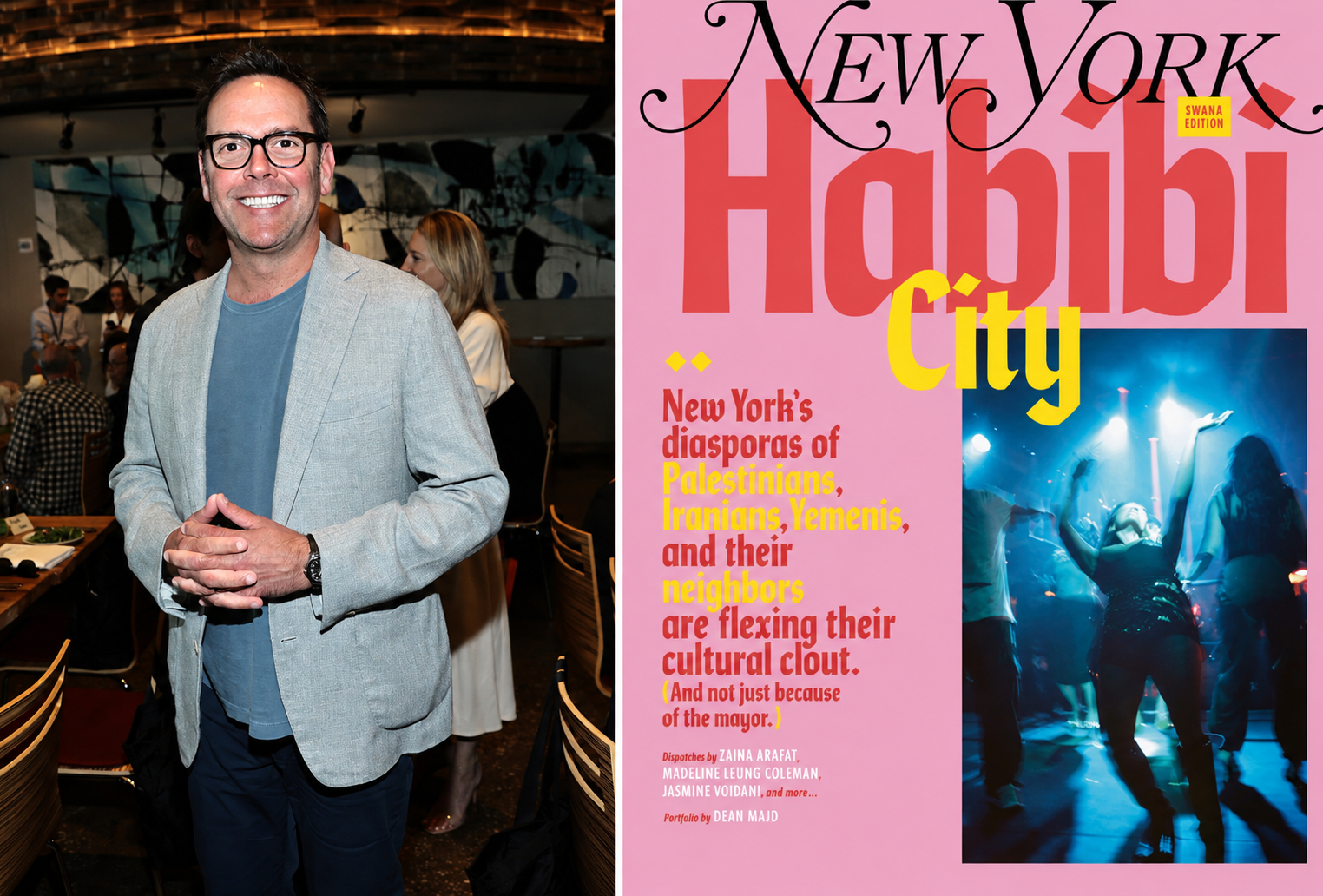
James Murdoch’s Lupa Systems company took control of New York on July 8, and New York’s “Habibi City” cover is being interpreted as a signal of his plans for what the press release announcing the transaction described as “the beginning of a new chapter.” Murdoch is not pushing back on that idea.
Vox, which was also part of the James Murdoch deal, on August 10 published an article calling for a U.S. embargo on arms to Israel. “The Democratic Party’s burgeoning support for restricting aid and arms transfers to Israel is well-founded,” the article said. “Supplying Israel with money and weapons is contrary to both America’s moral obligations and security interests. It is wrong to subsidize or provision any foreign military’s assaults on human rights. And doing so undermines global respect for both the United States and the concept of international law.” The article didn’t explain how it would be in the U.S. “moral” or “security” interest to allow its ally to be overrun by Islamist terrorists, rapists, and murderers, or to turn to alternative arms suppliers such as China or Russia instead of the U.S.
The New York magazine statement that it welcomes “good faith discussion and criticism” also is a not-so-subtle attempt to shift the question from the accuracy and integrity of the magazine’s journalism—which the CEO of the Anti-Defamation League, Jonathan Greenblatt, called “a blatant, disgusting double standard”—to the intentions of the magazine’s critics.
For the assignment to cover Middle Eastern food in New York City, James Murdoch hired a reporter, Coleman, who signed an October 26, 2023 “Statement of Solidarity with the Palestinian People” that claimed “Israel’s war against Gaza is an attempt to conduct genocide against the Palestinian people.” The statement said, “We come together as writers, journalists, academics, artists, and other culture workers to express our solidarity with the people of Palestine. We stand with their anticolonial struggle for freedom and for self-determination, and with their right to resist occupation.” Never mind the “good faith” of the critics, where is the good faith of an editor or an owner who makes such an assignment or publishes the false accusations of genocide it produces?
The articles are riddled with inaccuracies. One sentence in Arafat’s article—”A self-proclaimed Islam critic named Daniel Pipes had created Campus Watch, an organization that compiled a list of faculty ‘to avoid,’ whom it deemed critics of Israel”—contained three factual errors. Pipes critiques Islamism, not Islam, and never proclaimed himself an “Islam critic.” Campus Watch is not an “organization” but a project of the Middle East Forum. And the list of faculty to avoid is not “critics of Israel”—Pipes himself has criticized many Israeli policies—but “professors whose biases, ahistorical claims, apologetics, willful blindness, intolerance of opposing views, and mixing of politics and scholarship mark them as the most egregious offenders of the high standards to which faculty should be held.”
Meanwhile, denunciations of the New York “Habibi City” cover package are mounting. The New York Post, controlled by James Murdoch’s father Rupert and brother Lachlan, laced into it with an opinion piece by Commentary editor John Podhoretz. “New York Magazine’s evil ‘Habibi City’ cover sends a message: Jews aren’t welcome in Mamdani’s NYC,” the headline said. In the Free Press, Liel Leibovitz described Arafat’s article as “a perfect manifestation of a specific grad school sensibility, light on logic and high on pretense and self-importance.”
Read the full article here