



Almost 40 years ago, when he was still a new member of the Supreme Court, Justice Antonin Scalia gave a speech, later published as an essay, on how judges should interpret the Constitution. In “Originalism: The Lesser Evil,” Scalia argued that judges should interpret the Constitution’s words in accordance with how those words were interpreted by the generation that wrote and ratified them.
He was speaking specifically about judges—American judges; unelected, life-tenured judges who are bound to apply laws, not make them. As his title suggests, he warned his audience that originalism is not perfect, or easily self-executed. It is “not without its warts.”
“Its greatest defect, in my view, is the difficulty of applying it correctly.” And “it is often exceedingly difficult to plumb the original understanding of an ancient text.” And “done perfectly,” he conceded, “it might well take thirty years and 7,000 pages.”
Of course, here in the real world, judges can’t take 30 years and 7,000 pages to decide a case. And Scalia obviously knew that. His point was that judges, even the best originalist judges, often can’t do originalism perfectly. They need to do their best job possible, with the help of scholars and historians. But, in the end, they need to actually decide cases.
Decades later, originalism is the predominant judicial methodology for the Supreme Court, the lower courts, and more than just the courts. It is espoused by legal scholars and historians (if mostly on the conservative side), and by many politicians (if only nominally). Its success now carries so far beyond the judiciary that one can easily forget originalism was created for judges in particular.
So it was ironic, but significant, when Justice Samuel Alito gave a speech last year on “Originalist Judging,” asking (emphasis added): “what does originalism mean for a member of the judiciary who is called upon to decide cases that involve the interpretation of the Constitution?”
In that speech, Justice Alito described himself as a “working judicial originalist”—”that is, a judge who strives to achieve originalist aims while working within the framework of our judicial system.” And he distinguished proper judicial originalism from others’ attempts to make originalist constitutional interpretation too abstract, or too pedantic, or too ambitious for the real-world judicial work of deciding actual cases.
As it happens, Alito made a similar point nearly two decades earlier, in a speech at Columbia Law School. “Properly understood, originalism is not a formula that ineluctably provides a clear answer to every constitutional question that arises in litigation,” Alito said. Or, as he put it in a 2024 speech on baseball and the law: “Judging, like umpiring, requires judgment.”
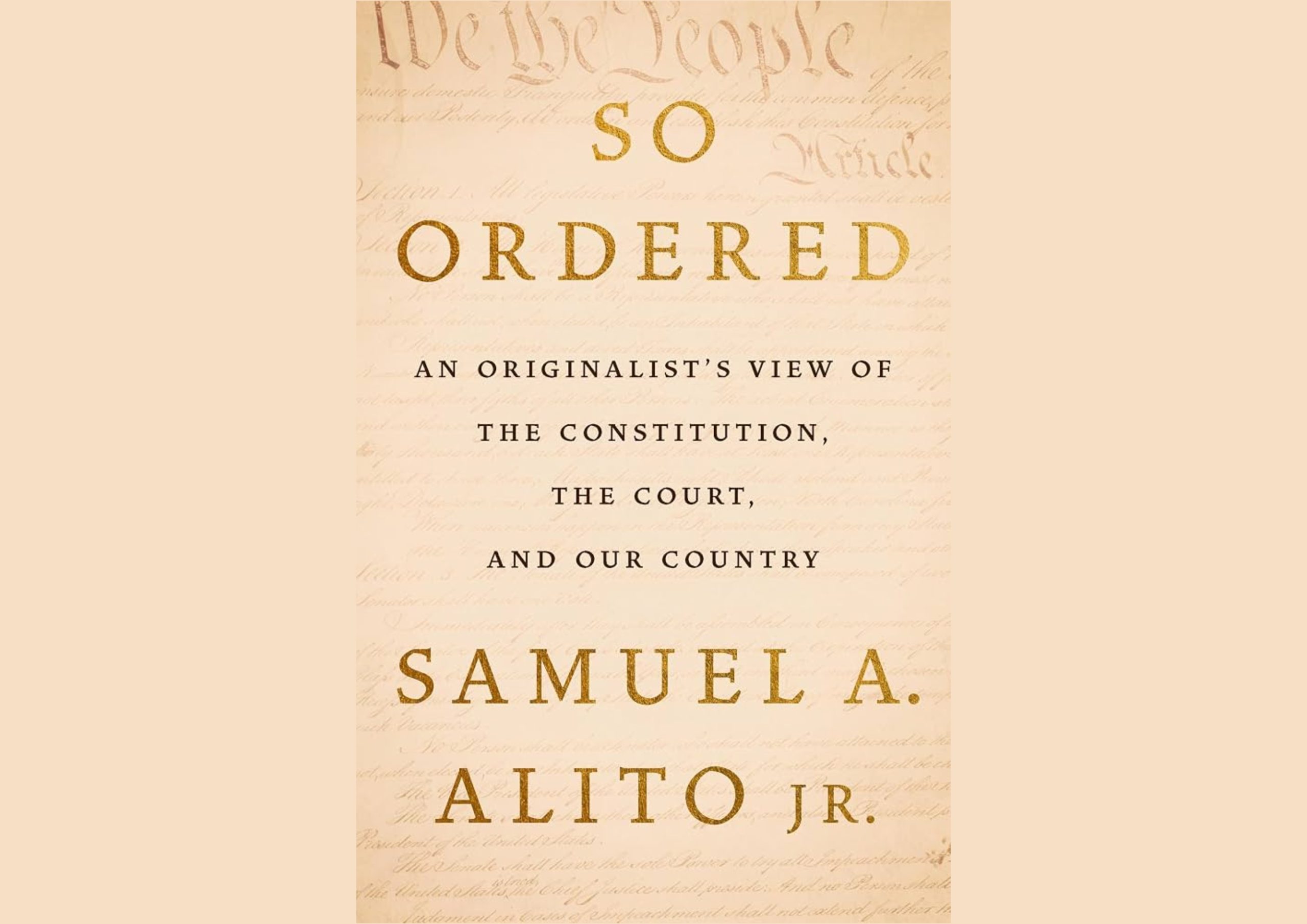
This is the core theme of his book, So Ordered: An Originalist’s View of the Constitution, the Court, and Our Country. Throughout his career, in interviews and speeches and—of course—in judicial opinions, Alito has shown over and over again how an originalist judge should grapple not just with the Constitution’s words, but also with statutes, precedents, and traditional practices—and with the ambiguities that come with all of it.
Now, in this collection of 19 speeches that he delivered between 2007 and 2025, Justice Alito offers a broad view of American law and American life. “Although the chapters in this book were not composed with the expectation that they would ever be united in a single volume,” he explains, “those chapters, taken together, express a view about how our constitutional system should operate and serve the society it has cultivated.”
To be sure, the book is not strictly about law. Its last batch of speeches, grouped under “The American Experience,” covers everything from “Man’s Desire for Meaning” to the notion of American “countercultures.” A speech on “Achievements of Italian Americans” includes a lovely tribute to his father and to the grandparents who brought him to America.
But, unsurprisingly, much of the book is dedicated to legal questions. It opens with his aforementioned speech on “Originalist Judging,” and then his argument for why judges should also apply originalist tools when interpreting statutes (“Textualism”). He also reflects on how constitutional originalism fits (and doesn’t fit) with various facets of Catholic thought, and he turns repeatedly to the current state of religious liberty in American law and politics.
America’s Novus Ordo Seclorum, its new order of the ages, included “a distinctive concept of religious liberty and its place in a republic,” he noted in a 2022 speech. “Understanding that concept is especially important at the present time because we have entered a period when religious liberty faces serious challenges,” he warned—a warning that recurs throughout several of his speeches.
These speeches on the law, especially his opening chapter on “Originalist Judging,” are significant for anyone who wants to understand the basic principles of Justice Alito’s constitutional jurisprudence.
But the book’s most significant speeches are not about jurisprudence in theory, but about actual jurists in practice. In his 2010 Wriston Lecture at the Manhattan Institute, titled “Let Judges Be Judges,” Alito implored judges (this time with his own emphasis) to “act like judges.” A judge is not a scientist, or reformer, or a rubber stamp or a crowd-pleaser. A judge must be “bound down by strict rules and precedents,” he notes, quoting Alexander Hamilton’s Federalist 78.
Interestingly, in praising the famous English jurist William Blackstone, Alito noted criticism of some of Blackstone’s accounts of the law, and conceded, “as a legal theorist, Blackstone may not get high grades.” If this seems like a criticism, it’s clearly not meant to be. In this speech, and throughout his other speeches on judges and judging, Alito notes repeatedly that judges are not simply theorists. In a speech on Learned Hand, arguably the greatest 20th-century judge not to serve on the Supreme Court, Alito specifically downplays Hand’s substantive ideas, but praises Hand as the consummate judicial “craftsman” in his actual work of deciding cases. Hand could write stirring speeches, but “he did that off the bench.” On the bench, he “appreciated the difference between judging and academic writing.”
Similarly, in his 2012 speech on “Burkean Constitutionalism,” Alito suggested that “Burke was not a philosopher or any other sort of abstract thinker.” Instead, “his writing married learning and reflection with the practical knowledge he derived from personal observation and experience.” And, Alito concluded, “[t]he best working judges have those same attributes.”
Even in the speech on his theory of textual interpretation, he pauses to warn, “I am no philosopher.” Quite the contrary—he’s a judge.
If this collection of speeches would have benefited from any further additions, it would have been one of his tributes to Judge Edward Becker, a former colleague on the U.S. Court of Appeals for the Third Circuit. In a remembrance published shortly after Becker’s death in 2006, Alito described “Ed’s vision of the way the courts should operate. … He felt deeply that every relevant fact and argument must be given full consideration. This was essential for good decision making and, in any event, was necessary in order to show simple respect for the attorneys, the parties, and the tribunal whose decision was being reviewed.” Nearly a decade later, when Justice Alito received a Philadelphia award named for Becker, he once again paid tribute to Becker’s public service and civic spirit, and encouraged judges, lawyers, and others to imitate his example. It surely would have fit well in this book’s section on judges.
Alito’s tribute for the judge he clerked for—Leonard Garth, also of the U.S. Court of Appeals for the Third Circuit—is somewhat hidden in Alito’s 2024 speech on “Baseball’s Lessons for Law and Life.” Given Alito’s famous love of baseball, that might be the best proof of his affection for Judge Garth.
“He was a fine judge and a good man,” Alito says. “I admired him deeply, and he taught me a lot.” One lesson from Judge Garth stands out in particular: “He told us, ‘It takes courage to be a good judge.'”
As it happens, Alexander Hamilton noted the same thing in his famous Federalist 78: Our Constitution depends on “an uncommon portion of fortitude in the judges to do their duty as faithful guardians of the Constitution.”
It is hard enough to find wise lawyers to appoint to the bench, and harder still to find those who “unite the requisite integrity with the requisite knowledge.” In this book, as in Justice Alito’s broader body of work, we find both.
So Ordered: An Originalist’s View of the Constitution, the Court, and Our Country
by Samuel A. Alito Jr.
Basic Liberty, 320 pp., $32
Adam J. White is the American Enterprise Institute’s Laurence Silberman Chair in Constitutional Governance and director of the Antonin Scalia Law School’s Center for the Study of the Administrative State.
Read the full article here