




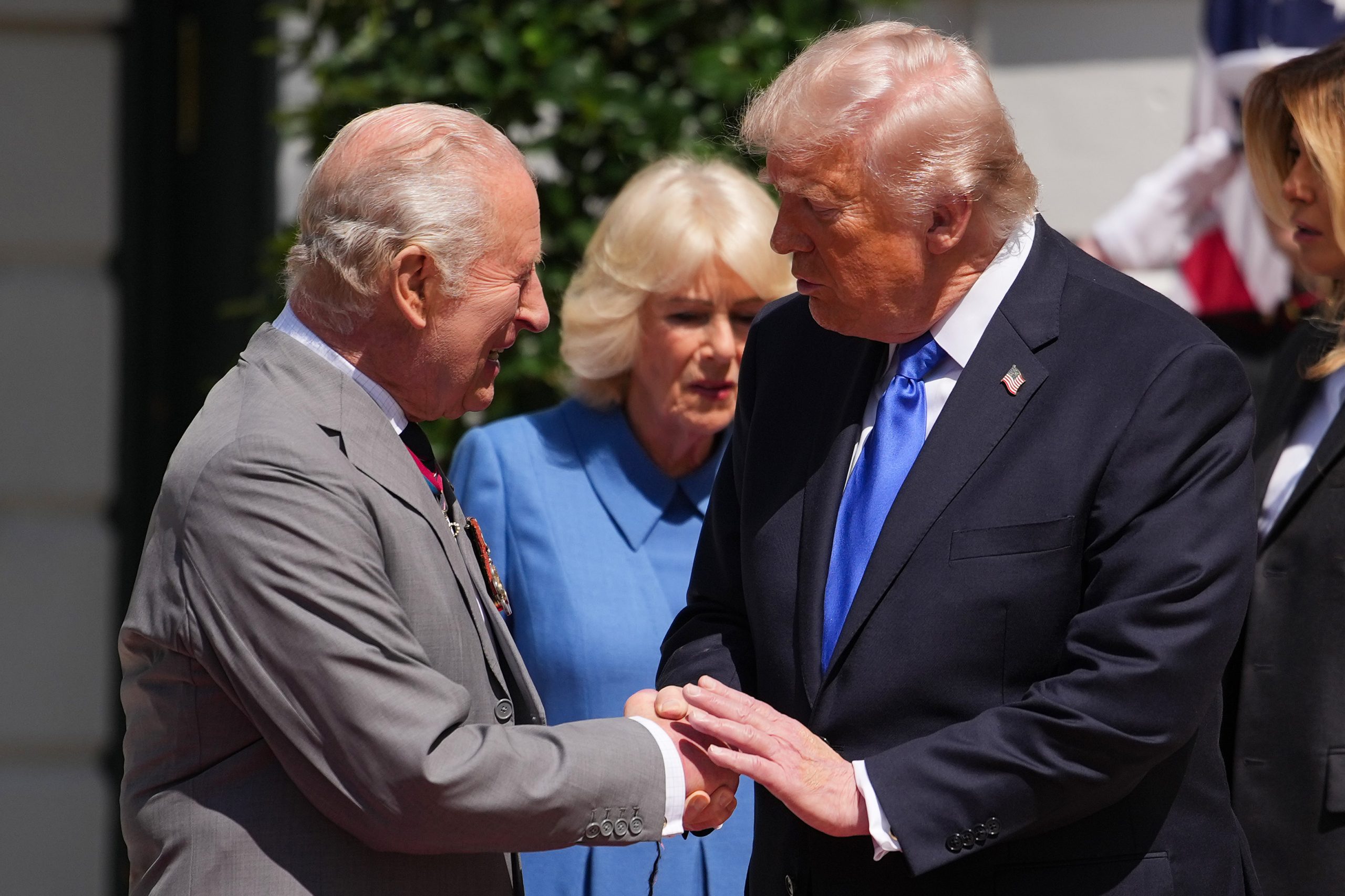
King Charles III’s trip across the Atlantic came at a difficult time. The Iran campaign marks a low point for the transatlantic alliance, his host country is preparing to celebrate the 250th anniversary of evicting his family’s rule, and the “no kings” protests remind Britain’s royals that many Americans still equate monarchy with tyranny.
So the great success of this royal state visit—President Trump called Charles “the greatest king” at the White House—reveals His Majesty’s underrated diplomatic abilities. Unfortunately, the trip also shows that Britain’s place in the world is diminishing.
Walter Bagehot noted over a century-and-a-half ago that British society depends on a “theatrical show” and the monarch is “the climax of the play,” and Charles wielded his star power effectively this week. His understated pageantry at the 9/11 Memorial in New York and Arlington National Cemetery reminded Americans of Britain’s deep sympathy during moments of national peril. And his gift to the president of a bell from a British-built submarine that was stationed in Australia and fought alongside U.S. forces, named HMS Trump, was a brilliant reminder of the value of the AUKUS tech- and submarine-sharing trilateral agreement.
Charles’s speech to Congress eloquently described the high points of Anglo-American culture too. As the king observed, “our nations are in fact instinctively like-minded—a product of the common democratic, legal, and social traditions in which our governance is rooted to this day.” These “common ideals were not only crucial for liberty and equality, they are also the foundation of our shared prosperity.”
This bond has important strategic implications. After the September 11 attack on American soil, “we answered the call together—as our people have done so for more than a century, shoulder to shoulder, through two World Wars, the Cold War, Afghanistan, and moments that have defined our shared security.” He encouraged his hosts to bring to bear “that same, unyielding resolve” to secure a good peace in Ukraine and to invigorate NATO.
The king is correct, but the “special relationship” did not endure because of the rightness of British opinions or America’s eagerness to learn from its former imperial overlord. Prime Minister Harold Macmillan made this mistake, once telling a colleague that the British were “Greeks in this American empire. You will find the Americans much as the Greeks found the Romans,” as a powerful but unsophisticated group in dire need of tutelage about statecraft.
Macmillan subsequently discovered his American counterparts were not eager pupils, and his reaction to that discovery has plagued British foreign policy since. After President Eisenhower rejected his advice to apologize to Soviet premier Nikita Khrushchev over the U-2 spy plane incident, Macmillan decided to throw in his country’s lot with Europe. Britain is an uneasy fit in the European community, though, and Charles de Gaulle humiliated Macmillan by vetoing Britain’s membership in 1963.
London is still veering unsuccessfully between Washington and Brussels. Brexit seemed to mark a decisive break with the European Union, but the Brexiteers could not find a consensus between the tech-oriented free-traders and the larger group who hoped that leaving the EU would halt further changes, not precipitate them.
The island kingdom is now focusing on Europe again. Charles argued to Congress that “an Atlantic partnership based on twin pillars: Europe and America” is “more important today than it has ever been.” But his prime minister, Keir Starmer, is pivoting his defense and security policy toward the continent.
Britain’s Europeanization has created significant problems. Its high-tax welfare economy grows at European rates rather than at much higher American ones. Charles lamented in Congress about climate change, but his country’s net zero carbon emissions target should come with its own warning label. The British military has fought valiantly alongside Americans, but the army is now smaller than in the Napoleonic era and the navy could not send a single destroyer to Cyprus after Iran attacked a British air base there.
Meanwhile, Starmer’s government has frayed its ties with Washington. It tried to give away the Chagos Islands to Mauritius, which would jeopardize American interests in the Indian Ocean. It also blocked the Pentagon from using our bases in Britain for the Iran campaign.
This is not entirely London’s fault. Brexit’s success largely depended on a generous trade agreement with Washington, and Trump does not give out sweetheart deals even to close allies. His bluster and threats over Greenland have alternatively enraged and terrified many Europeans too.
But Trump appreciates allies with agility and resolve. As British ambassador Christian Turner noted recently, “there is probably one country that has a special relationship with the United States—and that is probably Israel.”
Britain has demonstrated these qualities before, and can again. Charles can preside but not act. If Starmer does not change course, his country will be able to do neither.
Read the full article here