





My first encounter with a literary agent was in 1970, the year I worked in publishing for Quadrangle-New York Times Books. The agent was a man named Georges Borchardt. I was seeking the rights to publish a collection of the highbrow film criticism of his client Vernon Young. An Englishman, Young will always be memorable for me for informing Americans who too quickly called him by his first name that “My good friends call me Mr. Young. Won’t you do likewise.”
Georges Borchardt was a slender, well-turned-out man who spoke with a French accent. When I offered an advance of $2,500 for the Vernon Young book, he replied, “That’s not a very elegant sum.” Which led me to wonder where exactly, in money, elegance kicks in. We nonetheless closed the deal, and I found myself much impressed with Monsieur Borchardt. So much so that, a few months later, I asked him if he would agree to be my agent. He agreed, and so for more than 50 years after, until his death on January 18, 2026, at the age of 97, he remained. As my agent, he divested me of concern about my financial dealings with publishers and secured the publication of some of my books in China, Italy, Germany, and elsewhere. We were never close, but when in New York I usually called on him and always enjoyed his company. The last time we were in touch he told me that, owing to the silent French letter s at the end of his first name, many Americans thought his name was “Gorgeous.”
Anne Borchardt, Georges’s wife, handles movie and television rights for the Borchardt agency, and does it very well. She arranged four different options for me for one of my stories from the Hollywood producer Stanley R. Jaffe (of Kramer vs. Kramer and Fatal Attraction fame), and oversaw a contract I had with Warner Brothers to write a script based on another of my stories. None of this resulted in an actual film, but then it is said that the ideal arrangement for a writer is for Hollywood to pay him for the rights to his work, which never gets made and thus more likely than not vulgarized by the movie mind.
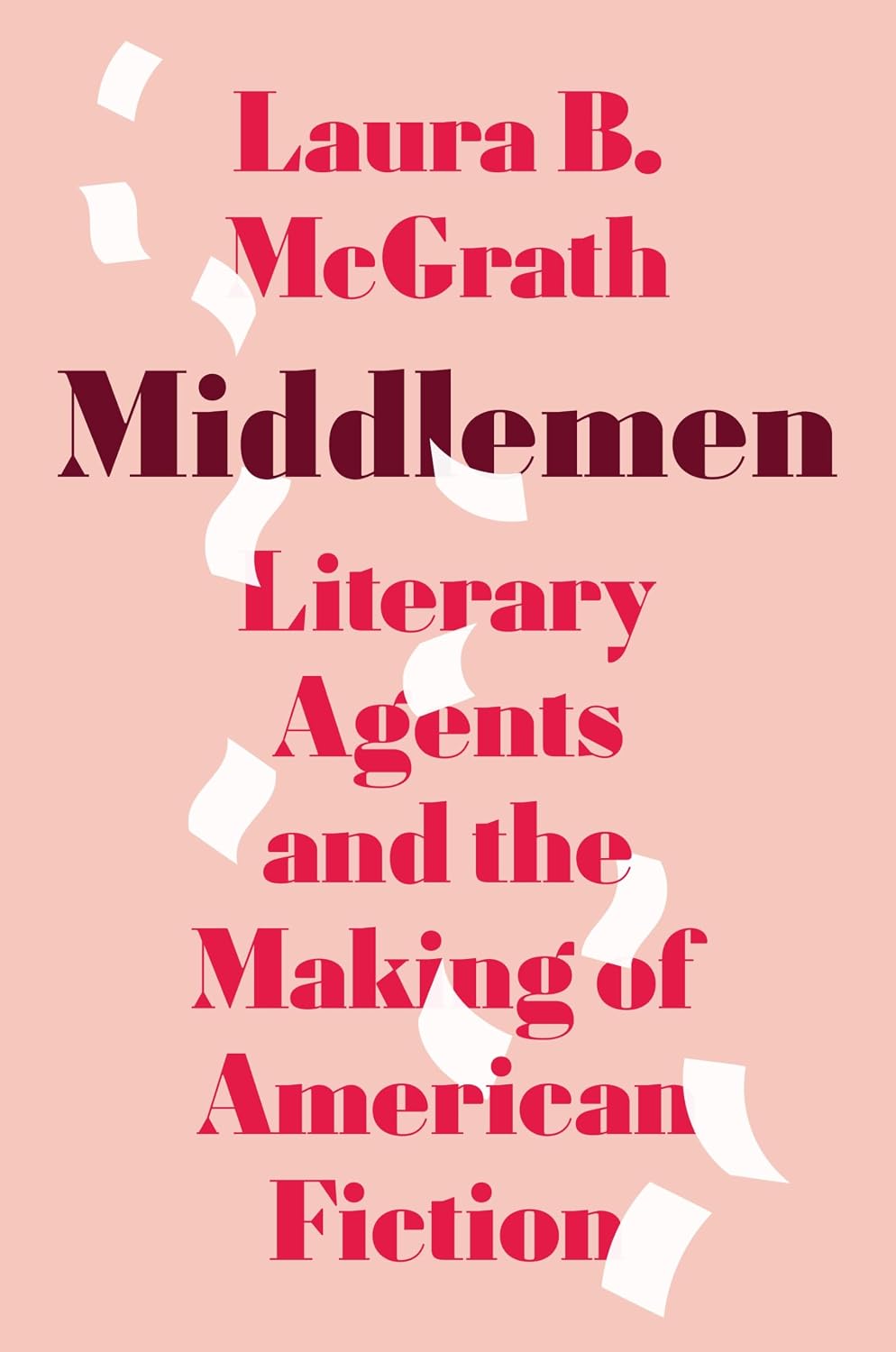
Georges Borchardt does not appear in Laura B. McGrath’s Middlemen: Literary Agents and the Making of American Literature. A professor of English at Temple University, McGrath sets out to show the importance of the literary agent in American literature. In doing so she emphasizes the role of the agent in discovering talent. “My aim in Middlemen,” she writes, “is to provide a new context for understanding major postwar American authors—to uncover the practices and consequences of gatekeeping, and to account for poorly understood or largely unexplained literary phenomena and the literary networks that produce them.”
Professor McGrath’s title, she tells us, is “tongue-in-cheek.” “Above all,” she writes, ” the term ‘middleman’ strikes an ironic chord because most literary agents are women. … As I write this, in 2025, the business is roughly 80 percent women.” She adds that “there are more than 1,500 literary agents in the United States. Most of them are white; most of them are women; most of them live in or near New York City.” The job of literary agent, she reports, is one based on apprenticeship: “taught by supervisors to assistants who, in turn, become supervisors of their own assistants and pass down the trade.”
The first requisite for a good literary agent, McGrath holds, is sound literary taste. Taste here entails the ability to espy literary talent, the rights to which can be sold and subsequently successfully published. Discrimination is perhaps the more precise word here, than taste. The good literary agent is able to discriminate between the likely commercially successful book and the excellent book whose commercial prospects are limited, yet promote both with publishers.
“Gatekeepers” is how McGrath characterizes the role of literary agents, those who “exercise significant influence over the process of developing manuscripts, well before an editor acquires and begins the work commonly associated with book publishing.” The majority of the agents she interviewed for her book claim to do a good deal of editing of the manuscripts they send on to publishers. “Literary agents,” she notes, “develop and edit manuscripts to make it easier for an editor to say ‘yes’ to a submission.”
In the current day, my sense is, young writers feel the need to have a literary agent represent them. Without such a figure behind their work, the chances of the book finding a publisher, they believe, is greatly lessened. If the book in question is a work in progress, the agent also arranges an advance (on royalties) for the author. This can sometimes be impressive, not to say spectacular, ranging in the six figures and even higher.
Distinctly not tongue-in-cheek is McGrath’s subtitle, “Literary Agents and the Making of American Fiction.” Behind the large claim implicit in this subtitle is that literary agents have discovered and made possible works of literature that might otherwise have been ignored. Two novels that she uses as examples are Jack Kerouac’s On the Road and Joseph Heller’s Catch-22. The agent for the first was Lynn Nesbit, for the second Candida Donadio (a name one can practically dance to). But are these novels great literature, as McGrath seems to think, or merely works of their day, no longer very readable in ours? A strong argument could be made—and I would make it—that these books are distractions merely, and well out of the main tradition of American fiction at its best, the tradition of Nathaniel Hawthorne, Herman Melville, Henry James, and Willa Cather. Georges Borchardt, meanwhile, rescued the Holocaust novel Night by Elie Wiesel, rejected by many publishers, which went on to sell 10 million or so copies.
Literary agents work for authors, not publishers, and so it is from authors that they collect their fees. For many years the standard agent fee was 10 percent of the royalties an author earned, though in recent years this number has gone up to 15 percent. The fee is also taken from any advance (against royalties) an author earns. Advances are supposed to be in place to help support the author as he or she completes work on his or her book, that is, if it isn’t complete when first shown to publishers.
Middlemen deals exclusively with works of fiction, where the advances paid by publishers tend to be relatively modest. In nonfiction, especially on books by famous people, they can be enormous. Robert B. Barnett, a Washington attorney who acted as a literary agent chiefly for politicians and royalty, in the words of his University of Chicago Law School obituary, “wielded enormous influence in the market for political memoirs and helped usher in the era of megadeals.” Barnett did not work for the standard literary agent’s commission but instead for a $750 or $1,000 an hour wage. The obituary notes that he won an advance for Hillary Clinton of $8 million for her memoir Living History, and $10 million for Bill Clinton’s My Life. Pocket change, this, next to the $65 million combined book deal he reportedly earned for Barack and Michelle Obama with Penguin Random House. He also arranged book deals for George and Laura Bush, Mitch McConnell, Madeleine Albright, and others.
Who reads these books, so many of them ghostwritten, with underlying political self-justifications, I do not know. I recall, many years ago, standing in line at a local Border’s Bookshop behind a woman who was buying five copies of Rudy Giuliani’s book Leadership, and wondering why anyone would do that? Was she, I wondered, Mrs. Giuliani?
The longest chapter in Middlemen is devoted not to a literary agent but to an editor at Doubleday/Anchor Books named Marie Dutton Brown. An African American, Ms. Brown is noted for promoting books by African Americans, both at her own firm and generally. Her career raises the question for McGrath of whether there exists a true black readership. She notes that literary agents are overwhelmingly white and adds that the reason contemporary literature is itself so white is “because agents are.” Low sales of books among blacks, she writes, “reinforced the stereotype that Black people do not read and are therefore an insignificant share of the market—publishing’s own prophecy fulfilling itself.”
Middlemen argues otherwise. McGrath writes that “much has changed since Marie Brown’s heyday—but far too little.” She contends that publishers are missing an important potential market of 20 million middle-class black readers. Still, one comes away from McGrath’s pages on this subject believing that blacks do indeed read, but chiefly books by black authors on black subjects, books that go largely unread by the upper-middle-class women who make up the main market for works of fiction.
In the end it is the job of literary agents to act as salesmen for their clients. Some do so by editing the works of their authors in a way that makes them more appealing to publishers. Others specialize in acquiring foreign rights for authors, thereby increasing their incomes and spreading their reputations. Many do both. To be sure, writers today can get along without agents, but fortunate indeed are those who have an excellent agent working on their behalf.
Middlemen: Literary Agents and the Making of American Fiction
by Laura B.McGrath
Princeton University Press, 296 pp., $29.95
Joseph Epstein is the author, most recently, of The Novel, Who Needs It? (Encounter Books).
Read the full article here