
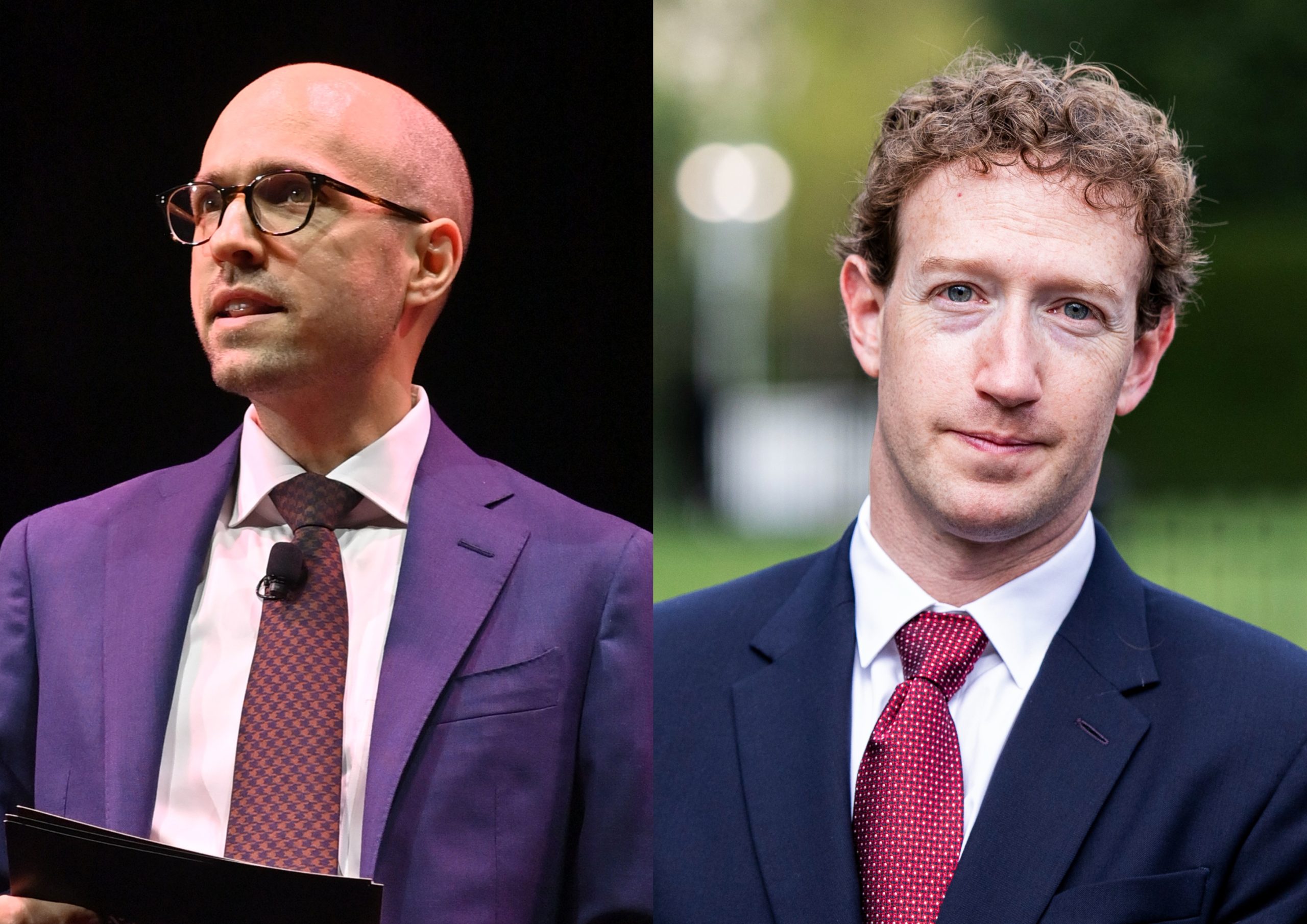





Sulzbergers soak up R&D tax subsidies while slamming Zuckerberg for ‘exploiting … untested accounting magic’
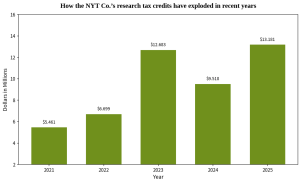
Here’s one fact the New York Times left out of its breathlessly hyped front-page story about how Facebook, Instagram, WhatsApp, and Muse.ai parent company Meta is “exploiting a lucrative tax break”: the New York Times Company itself has reaped $47.65 million in benefits from 2021 to 2025 from the same research and development tax credit it is complaining that Meta is using.
The Times article—with four bylines at the top and another two at the bottom for having “contributed research”—is another example of The Editors Rule of Byline Inflation, which is that the reliability of any news article is inversely proportional to the number of reporters who have a byline on it. The Times promoted it with its rarely used “Times Exclusive” label, and it festooned the article and the display text that accompanied it with loaded, disapproving, tendentious, and sensationalist adjectives—”lucrative,” “aggressive,” “risky.” It described the Meta practice as “untested accounting magic.”
Even the verbs were supercharged. A bar chart that appears with the article—with named credit to three Times staffers—purports to show “How Meta’s research tax credits have exploded in recent years.” Since the New York Times won’t tell you its own story in its news columns, only in the fine print of its Securities and Exchange Commission filings, here’s a similarly framed graphic generated by the Washington Free Beacon‘s own vast data visualization team.
Judging by the reader comments on the Times article, the piece had precisely the intended effect—fueling hatred against Meta CEO Mark Zuckerberg, who is too economically productive and Trump-adjacent for Times readers to stomach. The Times article begins with the two words “Mark Zuckerberg.” One reader comment that earned “Reader Pick” distinction by being upvoted by 795 Times readers said, “Absolute corrupt use of accounting and legal tricks. That’s why Trump loves Zuckerberg.” Another “reader pick” comment, from a Times reader in the failed country of Spain, said, “Meta is able to confidently make this bet because of who is in office and their ability to buy him.” The Times is trying to grow its circulation outside of America on the theory that non-American readers will be more receptive to the globalist anti-American, anti-Israel content it is attempting to get readers to pay for.
The Times makes a huge fuss about the fact that Meta discloses in Securities and Exchange Commission filings that it has tax-related risks. But the New York Times Co. makes similar disclosures in its own SEC filings; its 2025 Form 10-K includes more than $78 million in “other liabilities,” which the form says primarily included self-insurance liabilities, post-employment liabilities, and “contingent tax liability for uncertain tax positions.” When Meta does this, the Times news article hypes it as “Meta’s own accountants recognize that the strategy is on shaky legal ground. In disclosures buried in securities filings, the tech giant warns that billions in tax savings are vulnerable to being overturned by the I.R.S., in large part because of ‘uncertainties with our research tax credits.'” Yet the Times is doing pretty much the same thing. The only “magic” is the Times newsroom’s ability to make something sound suspicious when the non-Sulzberger rich try to use the same tax tools that the family that controls the Times uses to maximize its own profits.
The Times has cheerled for this tax credit in its pages in the past. A 2010 Thomas Friedman column headlined “A Word From the Wise,” about American competitiveness, reported “I had a chance last week to listen to Paul Otellini, the chief executive of Intel, the microchip maker and one of America’s crown jewel companies. … If the government just boosted the research and development tax credit by 5 percent and lowered corporate taxes, argued Otellini…” A 2007 Bruce Bartlett Times blog post named “making the research and development tax credit permanent (as Senator Max Baucus, the Democrat from Montana, who chairs the Finance Committee, has proposed)” among “the makings of a package that could produce something worthwhile and also have bipartisan support.”
The New York Times has a webpage devoted to its research and development and experimentation efforts, presumably in part for the purpose of providing justification for its tax credits. That page, in turn, includes a link to a site on the Medium platform containing typically self-congratulatory accounts of taxpayer-subsidized Times technology advances. My favorite was headlined “Designing a Digital New York Times Museum.” It tells the story of a Times team “tasked with designing a proof-of-concept that brings the internal company museum in the NYC office to remote employees.” The article says, “We want to reduce the cognitive load for visitors and prominent artifacts so visitors are not overwhelmed when they enter the virtual museum.”
I wonder how the New York Times would cover it if I tried to get federal research and experimentation tax credits for designing a digital Washington Free Beacon museum while minimizing the “cognitive load” on remote employee visitors. The Times is also keeping Sulzberger papers in the New York Public Library, sealed to public access, while it criticizes the Supreme Court for taking a similar approach to records access, as the Free Beacon reported last month.
I emailed the four authors of the Times article: “Isn’t it kind of hypocritical for the New York Times to go after Meta for its use of this tax credit, complete with loaded language like ‘aggressive’ and ‘accounting magic’ and ‘lucrative’ when the New York Times Company itself has taken $45 million in R&D/E tax credits over the past 5 years for projects like remote-employee access to a virtual NYT museum? How is what Meta is doing as detailed in your article any different or worse than what the New York Times Company is doing?”
I heard back from Times spokesman Charlie Stadtlander, who defended the story. He told the Free Beacon, “The Times’s reporting on Meta’s claiming of billions in tax credits is based on interviews with multiple people familiar with Meta’s operations, tax credit experts, and citations of Meta’s own securities filings that clearly outline the billions of dollars in risk these claims introduce. Incisive and revealing journalism like this performs a vital role in helping the public understand how one of the largest companies shaping the economy conducts itself. The Times is confident that our approach to R&E credits is appropriate.”
Maybe the “research and experiment” happening is how long any subscribers will continue to pay for this garbage.
Or maybe the real experiment under way is how long the market will continue to value the New York Times Company (NYT) at a price earnings ratio—26.51 or so—far richer than that of Google parent Alphabet (16.84), and roughly on par with that of Meta (27.37), as if the New York Times were an actual technology company rather than a family-controlled anti-Trump newsletter and podcasting platform that also operates a taxpayer-subsdized museum open only to employees. It’s one thing, as a member of the Sulzberger family, to be born into such an experiment. It’s another thing for a customer, talented employee, or capital-allocating potential shareholder with alternative options to choose voluntarily to participate in it.
Read the full article here