




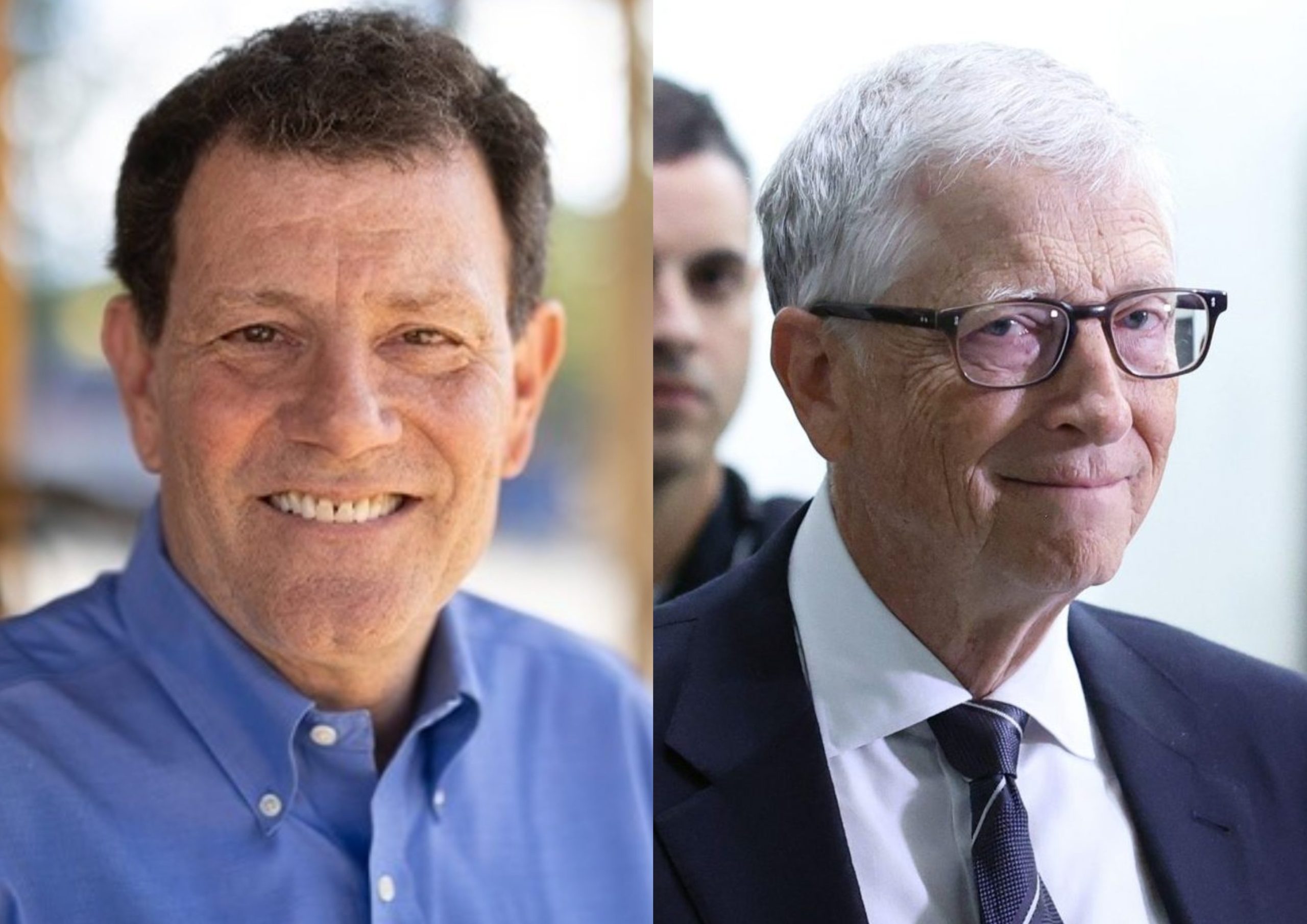
New York Times opinion writer Nicholas Kristof used his columns to promote the embattled tech mogul Bill Gates as recently as December 2025, long after unflattering revelations about Gates’s close personal ties to Jeffrey Epstein—and the Microsoft billionaire’s infidelities—spilled into public view. Kristof was even boosting Gates while denouncing Epstein for sexually exploiting women, according to a Washington Free Beacon review of the columnist’s writings.
Kristof has for decades used his columns to crusade against sex trafficking and the sexual exploitation of minors, both in the developing world and in the United States, but never mentioned Gates’s long-term relationship with Epstein, choosing instead to reinforce the billionaire’s image as a sage advocate for those in need.
Though Kristof wrote about the Epstein affair as recently as February, exploring “what trafficked girls think of Jeffrey Epstein and his pals,” he made no mention of Gates—a conspicuous omission given that the Times itself broke the news about the close relationship between Epstein and the Microsoft founder in 2019. The Wall Street Journal reported in late May that, much to Gates’s alarm, his “carefully cultivated public image has been shattered by revelations about his association with Jeffrey Epstein.”
Gates’s personal relationship was close enough, the billionaire recently testified to Congress, that Epstein tried to blackmail him, “working to use information about my infidelities — in addition to many lies that he layered on top — to pressure me to re-engage with him.” Gates now says it was a “grave error of judgment” to associate with Epstein and that while he knew of Epstein’s criminal record, he “did not fully understand the extent of the crimes he committed.”
In his 2015 book, A Path Appears, Kristof heralded the Gates Foundation’s work, claiming that its “investments save lives at a cost of $2,000 each.” He went on to write that “Gates’s most important legacy may well be not software, but the conquest of disease and hunger around the world.”
Kristof’s acknowledgement of Gates’s years-long association with Epstein would have been awkward given that used two separate New York Times columns, one in 2015 and one in 2019, to celebrate Bill and Melinda Gates’s love story and their shared focus on “gender and empowering women.” The 2015 column, headlined “Bill and Melinda Gates’s Pillow Talk,” described how the two talk in bed about saving lives. “On the foundation, there’s always a lot of pillow talk,” Melinda said. “We do push hard on each other.” The 2019 column, headlined “The Bill and Melinda Gates Romance Started With a Rejection,” described how Bill Gates drives his kids to school. The pair announced their separation in 2021. Among Melinda Gates’s concerns, the Wall Street Journal reported at the time, was Gates’s relationship with Epstein.
In February 2020, four months after the Times‘s exposé on Gates’s relationship with Epstein, Kristof heralded Gates as one of the lone voices who predicted the global coronavirus pandemic before it erupted.
“Bill Gates, who for years has been warning presciently about the danger of pandemics, bluntly cautions that this virus could be a ‘once-in-a-century pandemic,'” Kristof wrote from his perch in the Times‘s opinion department. “‘I hope it’s not that bad, but we should assume that it will be until we know otherwise,’ Gates said, and that seems prudent.”
Bill and Melinda Gates gave a combined $100,000 to Kristof’s abortive 2022 Oregon gubernatorial campaign, gifts Kristof did not acknowledge in his columns praising the former couple. The Times has now pledged to investigate the issue in the wake of a report from Semafor. In the years since his short-lived gubernatorial campaign—he was disqualified for failing to meet Oregon residency requirements—Kristof has repeatedly featured Gates in his columns, often approvingly citing statistics published by his nonprofit group, the Gates Foundation (formerly named the Bill and Melinda Gates Foundation prior to the couple’s divorce).
Kristof, in fact, appears to have played a key role in an elaborate effort by Gates’s advisers to burnish his reputation as a gentle, Mr. Rogers-like benefactor, rather than a philanderer socializing with a convicted sex offender. (Bill Gates’s relationship with Epstein came after the financier’s guilty plea to a sex offense.) In at least seven separate columns since 2019—after Gates’s relationship with Epstein was revealed in the Times‘s own news pages—Kristof has touted Gates as a prescient and prudent humanitarian whose philanthropic work is protecting the globe from pandemics and poverty.
The Times‘s newsroom and opinion section operate independently, which appears to have allowed Kristof to praise Gates’s “prescience” without acknowledging the stain on his reputation.
In October 2020, amid a fierce debate in the United States over the government’s response to the COVID pandemic, Kristof relied on Gates to accuse President Donald Trump of overseeing “the greatest failure of U.S. governance since Vietnam.”
“The Obama administration,” Kristof claimed, “updated this [pandemic] playbook and in the presidential transition in 2016, Obama aides cautioned the Trump administration that one of the big risks to national security was a contagion. Private experts repeated similar warnings. ‘Of all the things that could kill 10 million people or more, by far the most likely is an epidemic,’ Bill Gates warned in 2015.”
The following year, in a January 2021 column, Kristof defended Gates against online conspiracy theorists who opposed his heavy promotion of the COVID vaccine.
“Countless numbers believe QAnon nonsense that leading politicians are Satan-worshiping child-traffickers or think coronavirus vaccination is a plot by Bill Gates to plant computer chips in people,” Kristof wrote in a piece that accused “lame-duck” Trump of inciting an insurrection on Jan. 6 of that year.
At the end of 2022, Kristof decided to deliver his readers “good news” about developments in global health.
“Scientists are making significant progress on vaccines for malaria, reflecting what may be a new golden age for vaccine development. Immunotherapy is making progress against cancer (among other feats, it is keeping one of my friends alive),” he wrote. “A new gene editing technique may be able to cure sickle cell anemia; Bill Gates argues in his annual letter that the same approach may eventually offer a cure for H.I.V./AIDS as well.”
In a May 2023 column on educational reforms in Sierra Leone, Kristof noted Gates’s praise for a book authored by the country’s then-education minister, Moinina David Sengeh.
“Sengeh has just published a book, ‘Radical Inclusion,’ that has been lavishly praised by Bill Gates as a ‘must-read,’ and he brings star power and attention to Sierra Leone’s efforts,” Kristof wrote.
When Kristof bashed the annual United Nations gathering in September 2023, accusing world leaders of ignoring poverty and hunger, he presented the Gates Foundation as a solution to the problem.
“We know what to do. The Bill and Melinda Gates Foundation has outlined a path to save the lives of some two million mothers and children over a decade,” he wrote. “We have the tools and experience; we lack the resources and political will.”
Kristof again cited the Gates Foundation for a December 2025 piece about child deaths worldwide.
“Maybe the worst calamity to strike an adult is to lose a child. That has become increasingly rare, but in 2025, for the first time in this century, the number of children worldwide dying before the age of 5 is believed to have risen, by about 200,000, according to the Gates Foundation,” Kristof wrote.
Earlier that month, Democrats on the House Oversight Committee had released two tranches of photos disgorged from Epstein’s estate, including multiple photos of Gates with then-prince Andrew (who would lose his royal title over his association with Epstein) and Gates with multiple women whose faces were redacted.
Kristof’s affection for Gates didn’t go unrequited. The billionaire showered praise on Kristof’s book, Chasing Hope, in May of last year, arguing that “the world would be a much better place if there were more Nick Kristofs.”
The Times did not respond to a Free Beacon request for comment, but told Fox News earlier in the week that “editors from Times Opinion are reviewing” Kristof’s columns “to determine further clarifications for readers.”
“Previous political donations made by some people Nick Kristof mentioned in his columns should have been made more clear to readers,” a Times spokesman said.
Read the full article here