





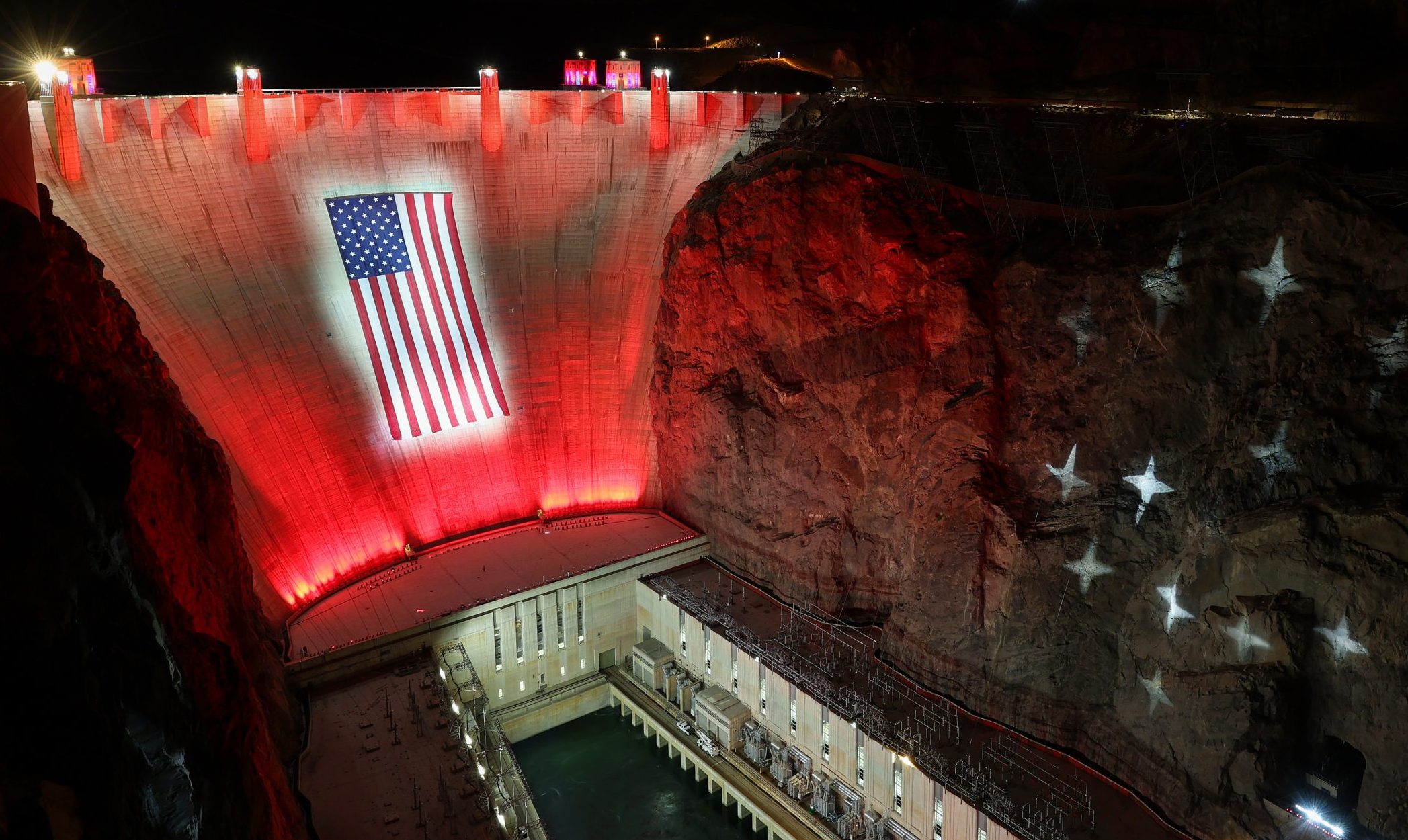
Americans will celebrate the 250th anniversary of the Founding tomorrow with an extravaganza of concerts, parties, fireworks, and parades. Our friends from abroad are joining the party with gusto: Yesterday, an armada that descended on New York Harbor as part of the festivities included service members from over 100 countries.
The signing of the Declaration of Independence is a world-historical event, and it is fitting that friends of freedom from all around the world hail it as one of the great advances in liberty. The Declaration became so consequential not merely because of the profound insights within it, but also because the signers got the geopolitics right. This country will only endure if Americans stay clear-eyed about both the great truths embodied in the Declaration and the grubbier realities involved in its defense.
The same day the Founders signed the document announcing their independence from the British Empire two-and-a-half centuries ago, a different armada bore down on New York Harbor. On July 2, 1776, British troops landed on Staten Island. As the ink dried in Philadelphia, the battle for New York began.
Many now think of the Declaration as the foundational text for understanding the ideas underpinning the American way, but the Continental Congress needed it to answer a more immediate and practical problem. The “glorious cause” of the American Revolution could not survive without funding, weapons, and military assistance that could only come from Europe, but no monarchs were interested in intervening in a local tax revolt. To get the support they needed, and to turn the rebellion into a global war, the Congress needed to convince Europe that the break with England was irreparable.
The prudent course would have been to downplay the anti-monarchical ideas driving the revolution, but that is not what the Founders did. Instead, they asserted “all men are created equal, that they are endowed by their Creator with certain unalienable Rights, that among these are Life, Liberty and the pursuit of Happiness.” They continued, moreover, “whenever any Form of Government becomes destructive of” their citizens’ rights, “it is the Right of the People to alter or to abolish it, and to institute new Government.”
This is still not the court politics version of How to Win Friends and Influence People. But they believed in their cause so strongly that they couldn’t help themselves but write it, even when they knew a diplomatic failure would mean their ruin and, almost certainly, their death.
Despite this outpouring of republican fervor, geopolitical realities pushed Paris and Philadelphia together. France armed and funded the revolution, and eventually allied with the Americans, because the benefit of harming their hated rivals in England was so apparent. Not for the last time, the Americans defended their way of life as part of an international coalition that fought around the world. The war began in Boston and spread as far as the Bay of Bengal.
The former colonists knew that if they prevailed, their revolution had the potential to change the world. As Alexander Hamilton wrote, “it seems to have been reserved to the people of this country, by their conduct and example” to show all if men could be governed by “reflection and choice” rather than by “accident and force.”
But for the American system to thrive, it needed to survive a dangerous international environment. The United States was effectively surrounded after the war. Britain still owned Canada to the north, Spain’s control of New Orleans could choke off westward expansion, and the Atlantic Ocean was a highway for any adversary’s fleet. The revolutionary-era Articles of Confederation also left the central government too weak to do much.
This could not last. As Hamilton told his fellow delegates at the Constitutional Convention, “no government could give us tranquility and happiness at home, which did not possess sufficient stability and strength to make us respectable abroad.”
The text of the Declaration of Independence has inspired freedom movements around the world and helped Americans understand their glorious cause. Abraham Lincoln called it the “apple of gold” at the heart of the American experiment. In his view, the Constitution was the “picture of silver” that would “adorn, and preserve it.” The Declaration’s “great principles of political freedom and natural justice” convinced the escaped slave Frederick Douglass that the Constitution was a “glorious liberty document.”
As Americans celebrate the 250th anniversary of the Declaration, many can see storm clouds on the horizon. Russia is still attacking Ukraine and threatening the United States and its allies, Iran has been bloodied but is vengeful, and China looms behind them eager to overturn the U.S.-led order.
The Founders would find this predicament all too familiar. To win their independence, they had to get the geopolitics right. To maintain it, they had to create and sustain a government that could effectively protect the American way of life. To preserve this precious heritage, we must too.
Read the full article here