



Library shelves the world over groan under the weight of magisterial tomes recounting the remarkable career of Sir Winston Churchill. What a pleasure to meet a new, blessedly compact study—engrossing and revelatory—of the 20th century’s most indispensable statesman.
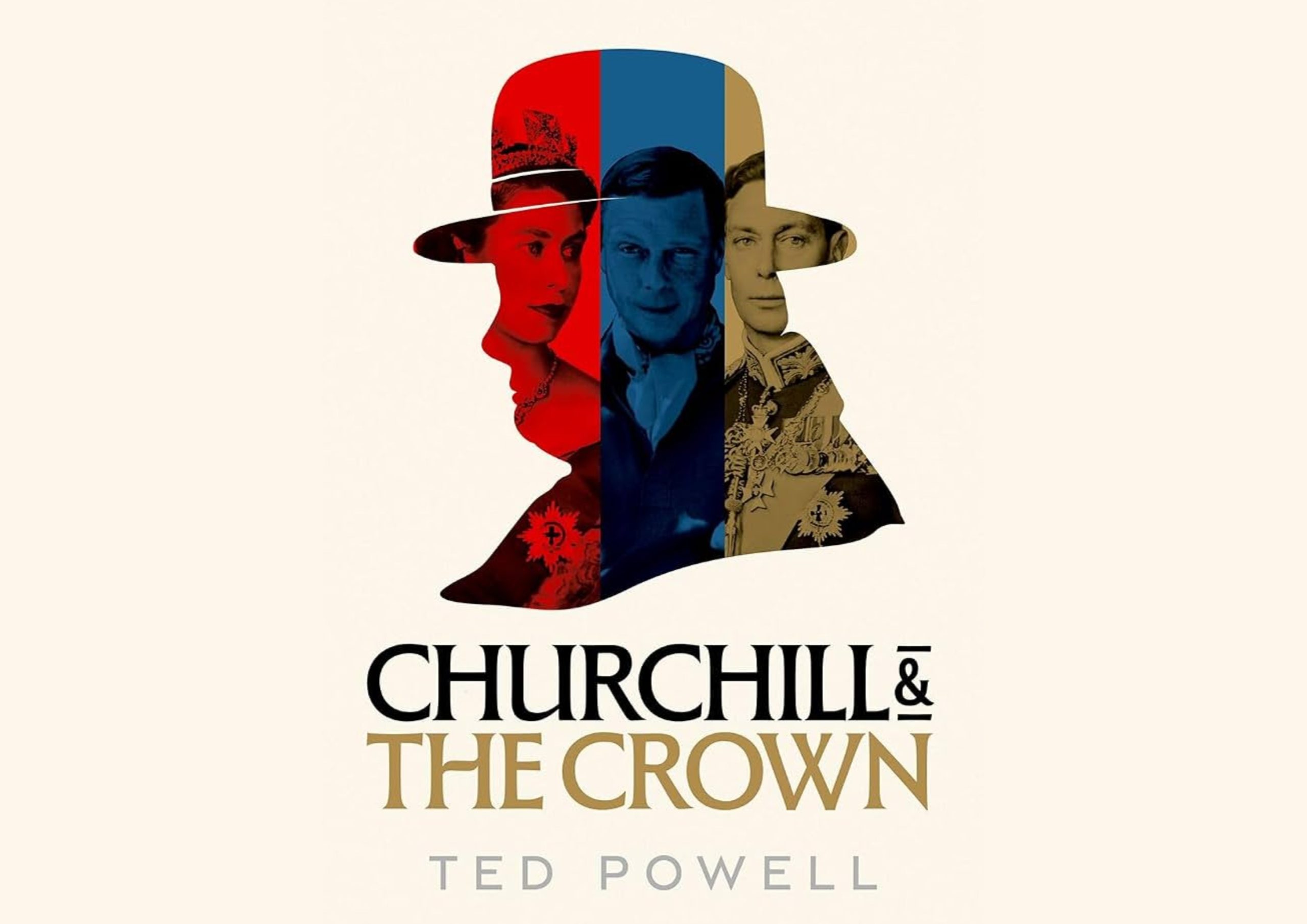
Churchill and the Crown carves out a juicy slice of the famous life as historian Ted Powell examines Churchill’s passion for Britain’s royal house—not simply the individuals, mind you, but all they stand for. As a politician, writer, and speechmaker, Churchill was ever the fierce defender of, and advocate for, the crown; in the author’s view, he was crucial to reinvigorating the monarchy and ensuring its survival to the current day.
Churchill came by his royalist convictions honestly—he inherited them. The first Sir Winston, known as the Cavalier Colonel, fought on the king’s side in the English Civil War of the mid-17th century. Churchill’s 6x great-grandfather, John, was made Duke of Marlborough and gifted the royal manor at Woodstock by Queen Anne in recognition of his military triumph at Blenheim in 1704. Both Churchill’s grandfather and father were prominent Conservative politicians who rose to be among the sovereign’s highest-ranking ministers.
For his part, Churchill could—and frequently did—boast of serving six successive monarchs. He caught only a glimpse of his first, Queen Victoria, while training for the army, into which he was duly commissioned, “By Her Majesty’s Command,” as a second lieutenant in 1895.
Churchill’s mother, the American-born beauty Jennie Jerome, persuaded her former lover, the Prince of Wales, to take an interest in her ambitious soldier son. While serving in the far-flung corners of the British Empire, Churchill corresponded with the man soon to be King Edward VII, a relationship that turned consequential once Churchill was elected to Parliament in 1900 at age 25. Edward admired the young man’s vigor but not his abandoning the Tories for the Liberal Party in 1904, nor his firebrand speeches on the stump. (The king wrote to him of one: “The country expects those who aspire to govern it to show some signs at least of their ability to govern themselves.”) Yet as an undersecretary of state in the Liberal government, Churchill flattered the king by regularly seeking his opinions, Powell writes, while fellow ministers “regarded the duty of consulting the monarch as an irksome chore.” And Churchill performed a sparkly service for the royal family in 1907 by smoothing the way for the leaders of the Transvaal Colony (later part of South Africa) to present the Cullinan Diamond, the largest rough diamond ever discovered, to Edward VII on his 66th birthday.
King George V, Edward’s stolid and unimaginative son, disdained Churchill. “Whereas Edward VII had regarded him almost indulgently as a high-spirited nephew,” Powell writes, “King George deplored his naked ambition, radical politics and”—it’s a refrain—”inflammatory speech-making.”
Sensing this, Churchill took to yanking the royal chain. In 1912, as first lord of the admiralty, he proposed naming a battleship HMS Oliver Cromwell after the leader of the 17th-century rebellion against the crown. King George was not amused, and the idea was eventually dropped, but not before Churchill wrote a lengthy peroration on Cromwell’s vital role in British history, which he dispatched to the sovereign for his enlightenment. Little wonder that, after the outbreak of World War I, when Churchill was dismissed for championing the disastrous Gallipoli campaign in 1915, no tears were shed in Buckingham Palace.
Tsar Nicholas of Russia, Emperor Charles of Austria, and Kaiser Wilhelm of Germany (the latter of whom Churchill had met and liked) were all toppled from their thrones by war’s end. Churchill would come to believe that the abolition of the European monarchies led directly to the rise of authoritarian despots in Bolshevik Russia and Nazi Germany. Already imbued with a providential view of his nation’s past, Churchill’s reverence for Britain’s unwritten constitution grew still greater. Had the tsar or the kaiser found their will constrained by a democratically elected parliament, he posited, they might have survived. “It is too much for one human being to unite in himself a great measure of executive power with the pomp of sovereignty,” Churchill wrote. “No one can be trusted to stand it and no one ought to have it.”
Rejoining the Conservative Party in 1925, and serving as chancellor of the exchequer in Stanley Baldwin’s first government, Churchill ensured that his dealings with the king were more cordial than previously, but his favorite royal was Edward, Prince of Wales. Churchill mentored the young man, 20 years his junior, as the prince took his first steps into public life, writing him letters of advice which were also, Powell writes, “larded with courtly flattery.”
Churchill’s affection for Edward contributed to the imploding of his political career. Excluded from Conservative government in the 1930s because of his unremitting demands that Britain rearm, Churchill had little contact with the prince, who ascended as King Edward VIII after his father’s death in January 1936. Churchill learned in November of Edward’s intention to marry his twice-divorced American mistress, Wallis Simpson, and Baldwin’s adamant opposition on constitutional grounds.
Politicians, Churchill contended, had no right to interfere with the hereditary principle of the royal succession. “Instinctively sympathetic towards his Sovereign’s plight, he suspected a plot to isolate the King and coerce him into abdication,” Powell writes. When a righteously indignant Churchill rose in the House of Commons on Dec. 7, 1936, to insist the beleaguered monarch be allowed more time to make his decision, he was shouted down by members of both parties. Powell recounts: “In his anger and frustration Churchill stalked out of the Chamber, and as he left, he shouted at Baldwin: ‘You won’t be satisfied until you’ve broken him will you?’”
Edward abdicated four days later, and Churchill, who had harbored hopes of succeeding Baldwin as prime minister, was instead cast into the wilderness for many months.
Churchill’s unlikely comeback, in the dark days of May 1940 with the fall of France imminent, did not please King George VI, who preferred his friend Lord Halifax succeed Neville Chamberlain, architect of appeasement, as prime minister. Not only was this king Churchill’s temperamental opposite—introverted, cautious, and lacking in confidence—he also felt wary of the brash personality who had once so ardently supported his brother, now the Duke of Windsor, a Prince-Harry-like source of constant irritation.
And, indeed, the two men got off on the wrong foot. Immersed in the exigencies of the moment, Churchill had little time to consult with the king. He ignored a letter from the sovereign advising him not to appoint Lord Beaverbrook, the maverick Canadian press magnate, as minister of aircraft production. When, in the midst of the Dunkirk evacuation, the king objected to a second appointment, Churchill sent a stinging rebuke to the king’s private secretary: “I should have thought that in the terrible circumstances that press upon us, and the burden of disaster and responsibility which has been cast upon me … I might be helped as much as possible.” The king hastily backed off.
Having established that he was not to be challenged on the make-up of his wartime administration, Churchill’s relations with the king improved. The threat of a German invasion receding, the PM began making weekly visits to the palace, and George VI became his sounding board; Churchill could consult, confide, and complain, “drop the mask of leadership and express his deepest fears,” Powell writes. For the king, the author notes, their discussions meant he was “no longer a passive spectator, but an active participant in the struggle.”
It’s a vivid portrait of the dance of deference that is the constitutional monarchy in action, on one side, the man with actual power listening respectfully to a man whose only authority is long lineage, on the other, the head of state by accident of birth allowed to suggest, but not dictate, how the welfare of the nation could be advanced. This section of Churchill and the Crown, drawn heavily from George VI’s wartime diaries, is the most remarkable.
Fascinating, too, is a chapter on how Churchill, convinced that the British system of government was uniquely successful as a political entity, was always keen to establish similar monarchies elsewhere—as British colonial secretary in the early 1920s, he helped install Faisal bin Hussein as the first king of Iraq, and Faisal’s older brother Abdullah as emir of Transjordan. In 1944, Churchill sent British troops to Athens to block a communist takeover and restore King George II of Greece. Churchill also supported the exiled King Peter of Yugoslavia, but could not prevent the communist revolutionary leader Josip Broz Tito from abolishing the monarchy and establishing his own regime.
King George VI was distressed when Churchill was thrown out of office by the British electorate at war’s end, but the two remained good friends until the monarch’s death in 1952. Churchill, recently back in power, now had a final chance to serve the House of Windsor. With Queen Elizabeth II only 25 at her accession, her prime minister could “undertake the congenial task of guiding and educating the new monarch in her constitutional duties,” Powell writes—while also postponing his own retirement.
Churchill’s colleagues noticed how he doted on the new sovereign. And during their palace consultations, Churchill confessed, he and the queen spent much of the time discussing their mutual passion for horse racing. Sales of Churchill’s books had earned him a small fortune, and now he, like Elizabeth II, owned a string of racehorses. These sessions proved a convivial career capstone for this unrivaled royal servant, faithful and adulatory to the end.
Churchill and the Crown
by Ted Powell
Oxford University Press, 272 pp., $34.99
Clare McHugh is the author of the novel The Romanov Brides.
Read the full article here