






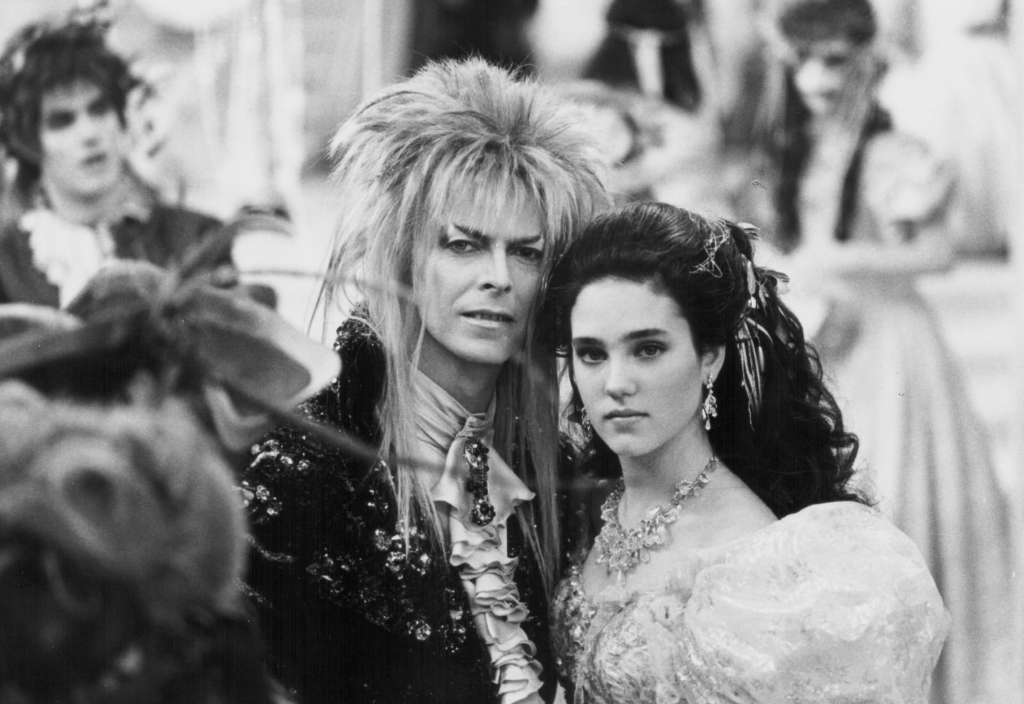
Have you ever longed to know The Dark Crystal‘s strange yet amicable cousin? Jim Henson’s 1986 coming-of-age acid trip Labyrinth covers every whimsical and weird base that puppetry can offer. Drawing from sources such as the paradoxical pieces of M.C. Escher and the medieval myth of changelings swapping babies with their own, the David Bowie-embellished journey immediately cemented itself into the weird fantasy hall of fame.
Sarah (Jennifer Connelly), a teenager wrapped snugly in her fantasy daydreams, is yanked into the reality of babysitting her infant stepbrother Toby for the umpteenth time. Her stepmother refuses to listen to gripes, and when she sees her favorite teddy bear in the hands of the baby, Sarah wishes for Toby to be whisked away by her book’s notorious goblins. To her horror, her wish is granted by the goblin king Jareth, David Bowie clad in skin-tight leggings and rumpled period-piece tunics. He declares that Sarah has 13 hours to find Toby in the labyrinth before the babe is transformed into a goblin permanently.
An Alice in Wonderland-inspired adventure unfolds within the sprawling titular labyrinth, complete with impressive special effects and the masterful artistry of Henson’s puppet work.
Sarah meets residents of the nightmarish maze on her way to Toby. A grumbling goblin with a soft heart, Hoggle leads Sarah through the labyrinth while struggling to comply with Jareth’s plans for interference over his growing affection for the girl. The fuzzy troll Ludo occupies the gentle-giant archetype, clinging to Sarah’s hand in many of his scenes. Sir Didymus, a debonair fox terrier knight atop his sheepdog steed Ambrosius, plows through goblin gangs and guards a swamp emanating an impressive amount of stock fart sounds.
Sarah successfully navigates the labyrinth, accompanied by her band of synthetic misfits, and rescues Toby from the clutches of Jareth. He laments his position, uttering the unforgettable “Just fear me. Love me. Do as I say, and I will be your slave.” Sarah rejects this, realizing her own power and his lack thereof, and sealing her transition from a girl to a woman. She returns home to her room, packed full of creature friends she met on her journey, ready to welcome her back to reality in a silly dichotomy of the real and make-believe.
Jim Henson pulled out all the stops to bring his vision to reality, a true marvel of puppetry and design. A shaft lined with hands was brought to life by 75 performers (that’s 150 total hands). A forest was brimming with 120 truckloads of tree branches. Jim Henson’s Creature Shop spent about a year and a half building the film’s puppets prior to filming. Set designer Elliot Scott and conceptual designer Brian Froud brought a devastating attention to detail; the Escher-inspired three-dimensional staircase and the largest panoramic black cloth ever made are among the most impressive of the production team’s feats.
A staggering set and lovingly molded worldbuilding established Labyrinth as its own triumph among weird classics like The NeverEnding Story and The Dark Crystal. The fantastical coming-of-age tale fused with Jim Henson’s culturally outstanding puppeteering work was, as many strange ’80s creations were, swept up by a cult following a couple of decades later.
One of the major aspects that resonated with young viewers was Bowie’s performance. This is not to cast Connelly’s achievements aside; many adult actors have expressed difficulty acting with nonhuman costars, a feat surely made all the more impressive by a 14-year-old. Still, Bowie, merely as himself, is a singular figure. It’s difficult to conjure another artist who could successfully harness the same mysticality of Bowie’s Jareth besides maybe Prince, whom Henson considered for the role, as well. Jareth’s look is nothing unfamiliar to a Bowie fan, his stature lending perfectly to his costuming and makeup to paint a villain of authority and strange prowess.
Bowie and Connelly’s numerous encounters in the film are undeniably charged. Jareth is a whirlwind of both fear and desire, an odd and oftentimes uncomfortable mix when paired with young Connelly. He expresses his longing for a union with her in most of their interactions, an itchy combination with his piercing, nitpicking gaze over Connelly’s face. Jareth clings to Sarah much like her naïveté, both of which she frees herself from upon the realization of her own autonomy.
The ending of the film leaves many doors ajar for the viewer to wander through. Was this all in Sarah’s imagination? What will become of Goblin King Jareth? What was going on in the ethereal ballroom scene (with Connelly clad in one of the most phenomenal gown designs in fantasy movie history)?
Although the script and overall pacing leave much to be desired, it would be foolish to dismiss Labyrinth because of it. The heart of the film lies in the meticulous execution of its visual identity, the copious layers of symbolism, and the fantastic performances of its human leads. The puppetry and set design, as well as the extreme hours that it requires, cannot be lightly brushed over in an industry that is being rapidly dominated by excessive CGI and bloated blockbusters. A fever dream of a children’s film, unafraid to frighten, Labyrinth remains a cornerstone of the strange and whimsical that is impossible to forget.
Editor’s note: This retrospective review is one in a series celebrating 1986, arguably the greatest year in movies—inarguably if you’re Gen X.
Mia Bowman is a journalist based in the Washington, D.C., area.
The post REVIEW: ‘Labyrinth’ appeared first on .
Read the full article here