





There’s a mini-vogue in publishing now not so much for group biographies (how very 2019!) but for histories that take two apparently contrasted dynasties or individuals and then tease out their parallels, as well as their differences. Following on from Carol Gardner’s The Divided North, which looked at the contrasting fortunes of black and white families in Portland, Maine, in the 19th century and Jonathan W. Jordan’s Ike and Winston, which examined the lives of Dwight Eisenhower and Winston Churchill during World War II and subsequently, Caroline Hallemann’s The Kennedys and the Windsors takes on the ambitious task of following the American royal family, of sorts, and the British royal establishment, and finding links and connections between the two.
Hallemann has the self-imposed difficulty that she is writing about two of the most discussed families in the world, who have been the subjects of countless earlier titles ranging from the brilliant to the perfunctory. Even the most committed Kennedy or Windsor obsessive is likely to feel that they know everything that there is to know about them, which makes her task a near-Sisyphean one. She deserves credit, then, for diving into a story straight away that manages to make the (mis)adventures of Joseph Kennedy, the family patriarch, seem relatively fresh and unusual, told as they are from this unusual perspective. When Old Joe, as he was known, arrived in Britain as U.S. ambassador in March 1938, complete with his family, it seemed for a short time like the perfect union of old and new worlds.
The Kennedys were glamorous, worldly figures who had not evaded their share of scandal—Joe was erroneously rumored to have made a fortune out of bootlegging, rather than sharply anticipating the end of Prohibition—but were still the living exemplar of East Coast sophistication. King George VI and his wife Queen Elizabeth were, by contrast, a homely and slightly uncomfortable couple who remained in the shadow of George’s elder brother Edward VIII, who had so notoriously abdicated his throne at the end of 1936 to marry the divorcée Wallis Simpson. Yet there was still an intrinsic majesty to royal life in Britain. When Joe and his wife Rose first visited Windsor Castle, he remarked, awestruck, “Rose, this is a helluva long way from East Boston,” while she lay awake in bed that night, guilessly thinking, “I must be dreaming that I, Rose Kennedy, a simple young matron from Boston, am really here at Windsor Castle, the guest of the Queen and two little princesses.”
Needless to say, Joe’s isolationist views did not go well come the outbreak of war, and he was sent packing from his ambassadorship in late 1940 after giving an ill-advised interview to the Boston Sunday Globe, in which he declared, “Democracy is finished in England.” He continued, “If we get into war it will be [finished] in this country too. … Everything we hold dear would be gone.” Pearl Harbor proved him wrong, but his family’s time in Britain had not been wasted; his daughter Kathleen, a.k.a. “Kick,” married an English aristocrat, and his adored eldest son Joseph Jr. would later return to Britain as a Navy bomber pilot.
One of the strangely fascinating aspects of the lives of both the Kennedys and the Windsors is that both families appeared to be cursed, and Hallemann is strong on the ways in which these extraordinarily strange runs of bad fortune manifested themselves. Everyone knows about the assassinations of JFK and his younger brother Robert. But of Joe’s nine children, four died before he did—two from shootings and two from plane crashes—and his eldest daughter Rose was lobotomized at a young age, on account of her extrovert and potentially embarrassing behavior, and therefore led a compromised life as a near-perpetual invalid. And the Windsors suffered their own share of ill luck, too. George VI, worn out by the effort of leading his country through war and heavy smoking, died of coronary thrombosis aged 56, and his flighty younger daughter Princess Margaret led an unsettled and erratic life after she was refused permission to marry the man she loved, Peter Townsend.
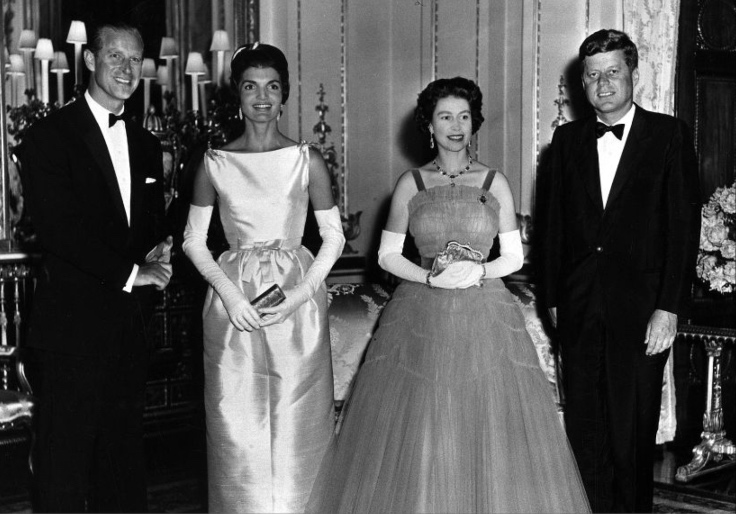
More recently, both the Kennedys and Windsors have continued to be in the news through everything from the death of Princess Diana and the aftermath, which continues three decades later in her younger son’s ongoing battle against the media, to the controversy over the appointment of RFK Jr. as secretary of health and human services. Hallemann is excellent when concentrating on the precise moments of crossover between the two dynasties, whether it’s the famous dinner party in 1961 when JFK and Jackie Kennedy were invited to Buckingham Palace to meet Elizabeth II and Prince Philip, or the slightly bizarre occasion in 1995 when JFK’s son John Jr. met Diana in secret at the Carlyle Hotel in New York.
His intentions were less romantic than businesslike—he wished to entice her to pose on the cover of a magazine, George, he intended to launch—but had it been made public, there would have been years of tabloid speculation about the precise nature of the relationship between the recently separated princess and the “world’s most eligible bachelor.” In any case, relations between the two dynasties were not always warm. Jacqueline Bouvier, as she first was known, might have described a meeting with the king and queen in 1948 as “the most exciting moment of [her] life,” but by the time that she had herself been elevated to first lady status, she was able to regard their successors more coolly. After attending Buckingham Palace and seeing the dynamic between Elizabeth and Philip, she allegedly told the no doubt agog Gore Vidal that “One felt absolutely no relationship between them” and sighed, “The queen was human only once.” Much the same might be said of her iconic self.
There is a lot to admire and enjoy about The Kennedys and the Windsors, which is written with both style and an attention to facts that makes it stand out among its more novelettish peers. Hallemann, thank heavens, makes no attempt to write the gushing semi-fantasy that some inferior royal and Kennedy commentators have churned out in recent years (naming no names, Omid Scobie) and her central thesis is a compelling one. Yet I couldn’t also help feeling that, at times, the book’s concept was strained beyond the point of plausibility. There is, understandably, more detail and authority when it comes to the goings-on of the Kennedys than the Windsors, most of which feels second-hand and well-worn. And structurally, there are issues, too. At times it feels as if there are a few pages on one dynasty, then a few on the other, and then a clutching-at-straws connection between some sartorial or presentational similarity between the two.
This is an easy book to recommend to casual Kennedy and Windsor fans, both of whom will undoubtedly find something that they didn’t already know inside its pages. But for the true aficionados of both doomed dynasties, who are longing to discover something truly revelatory, this will be a diverting but ultimately frustrating read that lacks the sensational new material that would make it an essential purchase.
The Kennedys and the Windsors: The Story of Two Dynasties, One Born, One Made
by Caroline Hallemann
G.P. Putnam’s Sons, 372 pp., $35
Alexander Larman is a journalist, historian, and author, most recently, of The Secrets of Eaton Square: Sex, Scandal, and Infamy on the Road to Buckingham Palace (St. Martin’s Press).
Read the full article here