






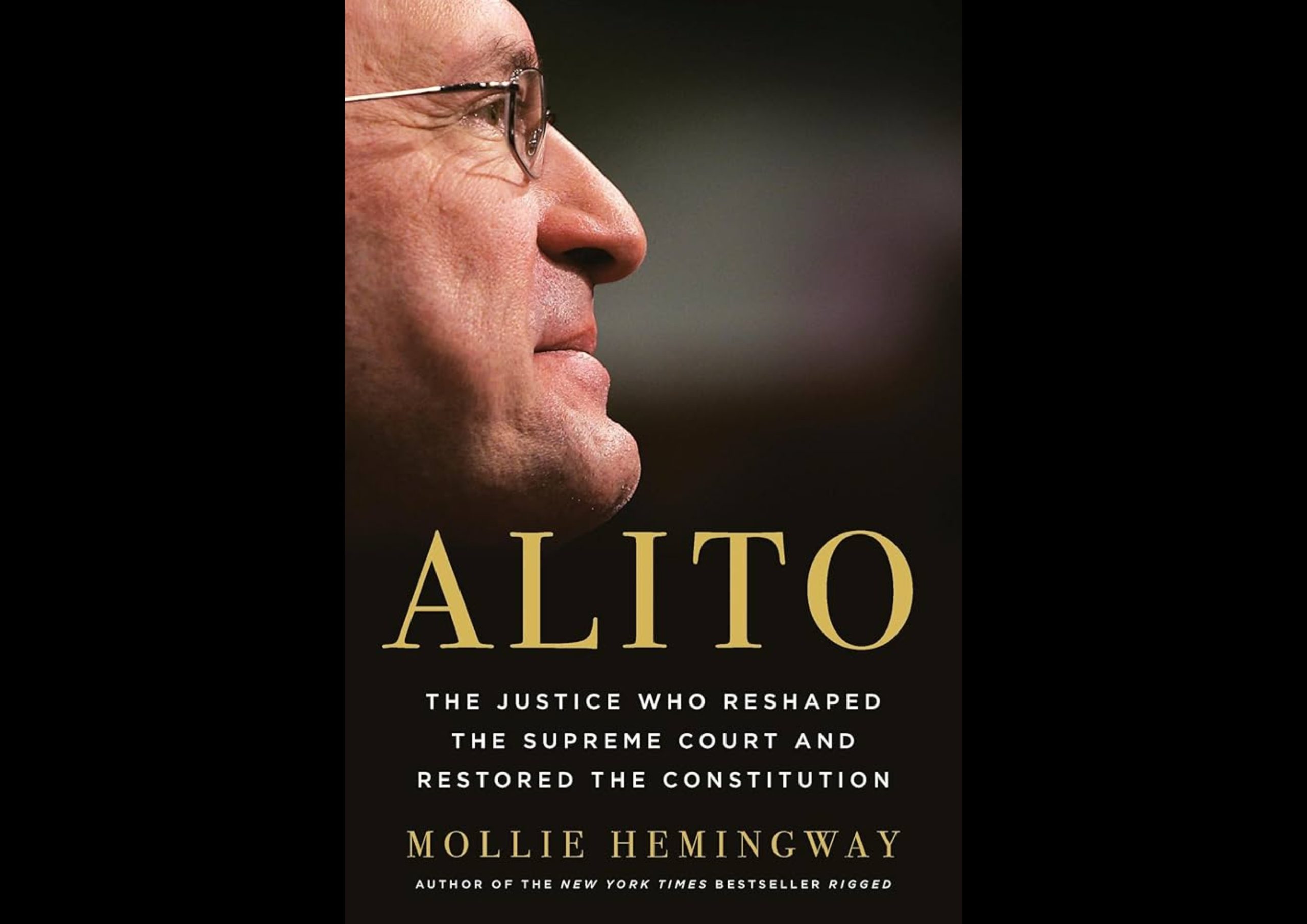
Mollie Hemingway has written the rare Supreme Court book that’s both useful and enjoyable. Alito: The Justice Who Reshaped the Supreme Court and Restored the Constitution works at once as biography, institutional history, and a kind of play-by-play of the Roberts Court in its most consequential years. It is, above all, a book about Samuel Alito’s jurisprudence—his “practical originalism,” as he calls it—but it’s also a book about courage: the courage to do the right thing in the face of elite panic, media hysteria, and actual threats of violence.
The timing feels right, doesn’t it? Jan Crawford recently reported that Alito has no plans to retire at the end of this term, which isn’t remotely surprising because he’s at the top of his game and has never had more influence.
But more importantly, the substance feels right. The core virtue of Hemingway’s book is that it reminds readers just how much of the modern Court’s drama turns on questions that are not especially dramatic in polite legal-company conversation: Who actually believes the Constitution means what it says? Who can withstand pressure? Who mistakes public relations for judging? Who has the stomach to overrule a notorious precedent when every institution in elite America is screaming for surrender?
Hemingway is very good on the long history of Republican judicial disappointments. When the Court decided Planned Parenthood v. Casey, eight of the nine justices had been appointed by Republican presidents, and the lone Democratic appointee was Byron White, who had dissented in Roe. That’s the story of GOP judicial-appointment malpractice in one sentence. The conservative legal movement didn’t become obsessed with vetting judges for nothing.
Hemingway is equally good on what makes Alito different. He’s not Scalia redux, despite the old “Scalito” smear, and he’s not Thomas either. Scalia preferred crystalline theory and rhetorical force. Thomas thinks strategically over the long term with remarkable intellectual audacity. For Alito, however, “judging is not an academic pursuit; it is a practical activity.” He starts with the premise that “the Constitution means something and that that meaning does not change,” but he’s also more willing than some of his fellow originalists to say when a question is bound up with messy real-world particulars. As Hemingway puts it, “Compared with more doctrinaire originalists, Alito is comfortable saying when questions before the Court are ambiguous and difficult to decide.”
That, in turn, helps explain why he’s become so effective. Hemingway quotes clerks joking that they can spend a month reading briefs and writing bench memos, only for Alito “to ask the one question at the heart of the case that makes contrary arguments collapse.” Anyone who listens to oral arguments knows that’s exactly right. I often tell people that if they want to know where a case is really going, they should pay close attention to Alito’s questions—and Justice Elena Kagan’s too. Even in unanimous cases, the key issues tend to show up there first.
The book is also full of sharply chosen details that illuminate Alito’s character without turning him into a plaster saint. When his wife first noticed him, she thought, “This one’s brilliant,” and apparently she also “loved the way he smelled.” A former clerk says, “Justice Alito needs clerks in much the same way a mother needs a toddler to help bake cookies.” Another line captures him well as a public figure: “No self-promoter, Alito was still largely unknown in political circles despite his impressive career and the growing admiration of his legal peers.” In a city full of peacocks, Alito isn’t merely non-flamboyant. He’s constitutionally indifferent to the forms of self-advertisement that Washington mistakes for substance.
Many of the best lines come from the people Hemingway quotes: friends, former clerks, insiders. She notes that her work is based on interviews with nearly 100 people. The result is both thoroughly researched and deeply reported. Hemingway is not just retelling public episodes; she’s adding to the public record.
And the biggest addition to that record is unquestionably her account of what transpired after the leak of the draft of Alito’s majority opinion in Dobbs v. Jackson Women’s Health Organization, the case that overturned Roe v. Wade.
The leak itself was unprecedented and corrosive enough. But Hemingway goes further, and what she reports about the internal conduct of the liberal bloc is extraordinary. After the draft leaked, the majority justices faced a genuine security crisis. The Alitos were moved to a secure location, Justice Amy Coney Barrett had to put on a bulletproof vest in front of her children, and an armed would-be killer appeared outside Justice Brett Kavanaugh’s home. Elsewhere Hemingway notes the justices and even family members were given increased protection because the leak made the conservative justices “targets for assassination.”
Under those circumstances, one might think the dissenters would have hastened to finish their work so the Court could issue the opinion and end the period in which murder might change the outcome. But Hemingway reports that after Alito urged the dissenters to hurry because delay itself was a security threat, they refused to give a completion date, and that Justice Kagan went to Justice Stephen Breyer’s office and pressured him not to accommodate the majority, “screaming so loudly … that the wall was shaking.” This is the book’s real scoop, and it’s appalling.
Kagan has long enjoyed a reputation as the smartest and most strategic of the liberal justices—a low bar currently, but she’d clear it with almost any colleagues. Yet she comes off poorly here, not ideologically but temperamentally. Hemingway reinforces this impression later, describing Kagan’s post-Dobbs public campaign about the Court’s legitimacy and noting that Alito responded, correctly, that criticism of opinions is one thing but implying that the Court is illegitimate “crosses an important line.” The pattern is hard to miss: media pressure outside the Court, emotional pressure inside it, always in the service of preserving liberal judicial victories that can’t be defended on constitutional grounds.
That’s why Dobbs is the inevitable climax here. Hemingway does well to show that overturning Roe was not some wild lurch into radicalism, but the delayed correction of a disgrace. She quotes David Brooks of all people: “Unless Roe v. Wade is overturned, politics will never get better.” Roe poisoned constitutional law and democratic politics for half a century. Dobbs didn’t create the conflict; it returned the issue to the people after decades of judicial usurpation.
And that required the particular kind of justice Alito is. Not a showman. Not a dabbler in atmospherics. Not someone forever reading New York Times editorials as though they were an appendix to Article III. Just a serious man doing his job. Hemingway’s formulation is apt: “The Roberts Court has become the best Court in decades”—and Alito has been central to that transformation.
There are books to be written about the current Court with more academic focus, and there may even be more “balanced” ones, in the modern, performative sense of that word. But there can hardly be better ones. Hemingway has produced an informative, lively, and often revealing portrait of a justice who has done as much as anyone to restore the Constitution to something like its proper place.
In a saner political culture, that would make him admired. In ours, it mainly makes him a target. Which is one more reason this book matters now.
Alito: The Justice Who Reshaped the Supreme Court and Restored the Constitution
by Mollie Hemingway
Basic Liberty, 352 pp., $32
Ilya Shapiro is director of constitutional studies at the Manhattan Institute, senior counsel to Burke Law Group PLLC, and author of Supreme Disorder: Judicial Nominations and the Politics of America’s Highest Court. He also writes the Shapiro’s Gavel newsletter.
Read the full article here