





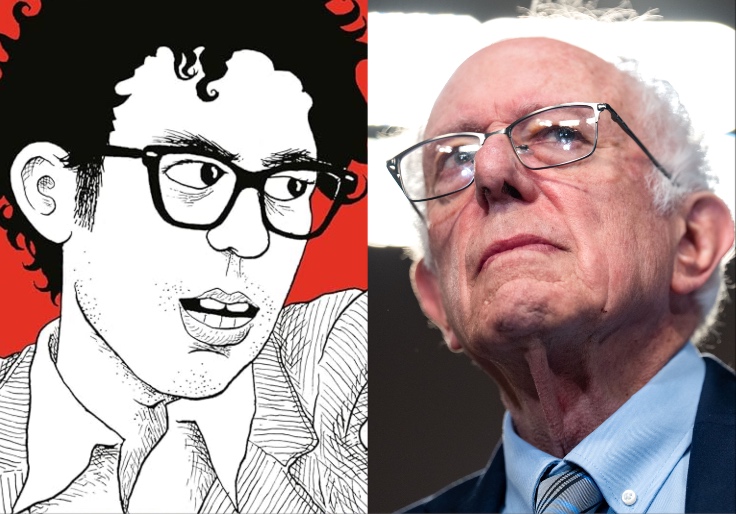
Even if you loathe Bernie Sanders, you will adore this phenomenal and utterly charming 500-plus page love letter to the state of Vermont and its people. Superbly written—Chiasson is a Wellesley College English professor and a well-known poet—it is also immersively researched, since Chiasson, who’s now 55, grew up in Burlington during the 1980s when Sanders served as the small city’s mayor for eight years. The only child of a struggling single mom, Chiasson interweaves his own teenage memories with Sanders’s unlikely political rise, and the result is as compelling and enjoyable a book as you will encounter this year, or any other.
Following a Brooklyn childhood with deeply unhappy parents and teenage admiration for Cuban communist leader Fidel Castro, Sanders got himself to the University of Chicago, where in August 1963 he was charged with resisting arrest during a civil rights protest. Later that month he attended the March on Washington, and following his 1964 graduation a short-lived marriage included the young couple spending several months on an Israeli kibbutz.
By 1966, notwithstanding his U of C degree, “Sanders had lost his way,” Chiasson writes. In 1968 he moved to Vermont, working as “an itinerant carpenter and freelance writer,” and fathering a son, Levi, with a temporary partner. In 1971 he moved to the “stagnating city” of Burlington and became a perennial, also-ran political candidate for Liberty Union, “Vermont’s nascent peacenik party.” Running twice for the U.S. Senate and twice for governor, Sanders’s best showing was 6 percent in a 1976 race, albeit one in which he doubled that percentage among his neighbors in Burlington’s deeply poor north end.
Reporting a net worth of $1,000 that year, Sanders too was poor. He “appears to have had little source of income for much of the 1970s,” living “on almost nothing for years,” Chiasson reports, adding that at times Sanders “was certainly on public assistance.” One friend told Chiasson that Sanders “feared homelessness,” and another confessed that “he lacked clothes” and “I fed him.” In 1977 Sanders quit Liberty Union, leaving him “estranged from his closest political allies,” and forever thereafter he would be a politician without a party.
Chiasson rightly stresses that “Bernie’s message has been a refrain, incessant and unchanging, since the early 1970s.” Embracing “the struggles of the working people against the banks and corporations which own and control the state and the nation,” Sanders identified with the two-thirds of Burlingtonians who lived in rental housing in a state where roughly one-sixth of the population—including Sanders—lived below the poverty line. While some Burlington circles were “a hothouse world of white progressivism,” Chiasson stresses that Sanders was “never part of the cultural left.”
It was with the residents of a sad-sack public housing project, “Franklin Square, on Halloween night in 1980, that Sanders’s political life started over,” Chiasson writes. That was thanks primarily to an almost-80-year-old “freelance political gadfly” and Vermont state representative who had mastered vote-harvesting among Burlington’s poor: “Sadie White played the decisive role in Bernie’s rise,” Chiasson states. Less than a month later Sanders declared he was challenging incumbent Gordon Paquette in the March 1981 mayoral race.
Burlington’s largest tax-exempt institution, the University of Vermont, “was regarded by much of Burlington as a foreign country, if not a hostile power,” Chiasson memorably observes, especially given how drunken students living in countless rental properties terrorized older neighbors, i.e., voters, with noisy late-night parties. As a mayoral candidate, Sanders was “the university’s chief antagonist from the beginning,” and he and volunteer aides knocked on most Burlington doors, including that of the grumpy maternal grandparents with whom Dan and his mother lived. Soon to turn 10, he witnessed “the tense exchange that launched my curiosity about Bernie in the first place, and out of which this book flows.”
Aided by a unanimous endorsement from the Burlington Patrolmen’s Association, Sanders astonishingly eked out a 10-vote victory over Mayor Paquette. A few days later, in search of an explanation, a perceptive Burlington Free Press journalist reported that “Sanders has genuine ties to poor people, public housing tenants and blue-collar workers.” His self-identification as a socialist played no meaningful role in the election.
Chiasson’s account of Sanders’s mayoral years will likely remain definitive for all time. Neither Sanders nor Jane Driscoll Sanders, his mayoral aide whom he later married, spoke with Chiasson, but it’s no exaggeration to state that virtually everyone who had any meaningful relationship with Sanders did so, usually at considerable length, and the result is as rich a work of political and cultural history as anyone with a Ph.D. could imagine.
Perhaps surprisingly to almost everyone, once in office Sanders governed as “an innovative capitalist,” Chiasson rightly observes, and many local leftists “felt spurned and abandoned by Mayor Sanders.” Bernie was, of course, “not naturally gregarious”—he “was always happiest and most himself on a pickup basketball court,” not a conversational venue. Chiasson memorably calls him “perhaps the world’s least social politician,” and early in his mayoralty Sanders’s top staffers reprimanded him for not being personable: “You don’t smile” and “You are not nice to people—you see people on the street and walk right past them—no hello, or handshake, or acknowledgment that they exist.”
Nonetheless, Sanders was easily reelected in 1983 and 1985, and over time his administration “dramatically changed the direction of the new Burlington.” Of course Bernie’s “totally unchanging and inimitable personal style—the hair, the clothes, the glasses, the voice”—in time became appealingly familiar. “Sanders’s charisma drove a transformative policy agenda,” Chiasson asserts, yet “the thought that Bernie would eventually break through as a national figure of historic impact would not have occurred to any Burlingtonian of the era.”
In 1986 the indefatigable candidate launched a hopeless independent run for governor, winning only 14 percent, yet the following year Burlington reelected Sanders for a fourth mayoral term with a 55 percent majority. In 1988 Bernie garnered 39 percent of the vote in a losing race for Vermont’s sole congressional seat, and he declined to run for a fifth mayoral term despite a poll showing 60 percent of city voters wanted him to.
Sanders left office with Burlington “a thriving, dynamic city, near its historic peak of prosperity and appeal,” Chiasson declares, and Sanders’s equally successful mayoral successor called Sanders “a moral visionary, articulating the goals, the moral goals, of the community.” More succinctly, future Vermont governor Howard Dean told Chiasson that Bernie “didn’t lie, which is refreshing in politics.”
In 1990, now with backing from the National Rifle Association in a state with more than 50 percent gun ownership, Sanders ran successfully for Congress, defeating the Republican incumbent to whom he had lost two years earlier with 56 percent of the vote. A close friend explained the seeming incongruity of Sanders’s anti-gun control stance by telling Chiasson that Bernie “doesn’t care about guns, he cares about the elitism of people who think they’re above the gun owners.”
Bernie For Burlington concludes with Sanders’s departure for Congress, and Chiasson insightfully emphasizes that “the power of Bernie’s libertarian rhetoric to supersede his socialism” is the key to understanding Sanders’s ongoing popularity in Vermont and his emergence as “the most influential leftist politician in the modern history of the nation.” After eight terms in the House, and now in his fourth term in the Senate, Sanders, who is 84, will have served 40 years in Congress when this term concludes in 2031. His message remains unchanged—”Let’s take America back from the millionaires and corporations that dominate it”—despite his current preference for private jets and a net worth of $2.5 million.
In a truly memorable coda, the book ends with Chiasson going to see Sanders at a summer 2024 picnic in the small Vermont village where he had lived more than a half-century earlier. “I told Bernie only that I was from Burlington, and had grown up during his years as mayor. It was a thrilling place to grow up, I said. I told him it made me who I am.” Not knowing who this was, the laconic Sanders mustered no more of a response than “Oh boy.”
Bernie For Burlington: The Rise of the People’s Politician
by Dan Chiasson
Knopf, 569 pp., $35
David J. Garrow’s books include the Pulitzer Prize-winning Martin Luther King Jr. biography Bearing the Cross and Rising Star: The Making of Barack Obama.
Read the full article here