
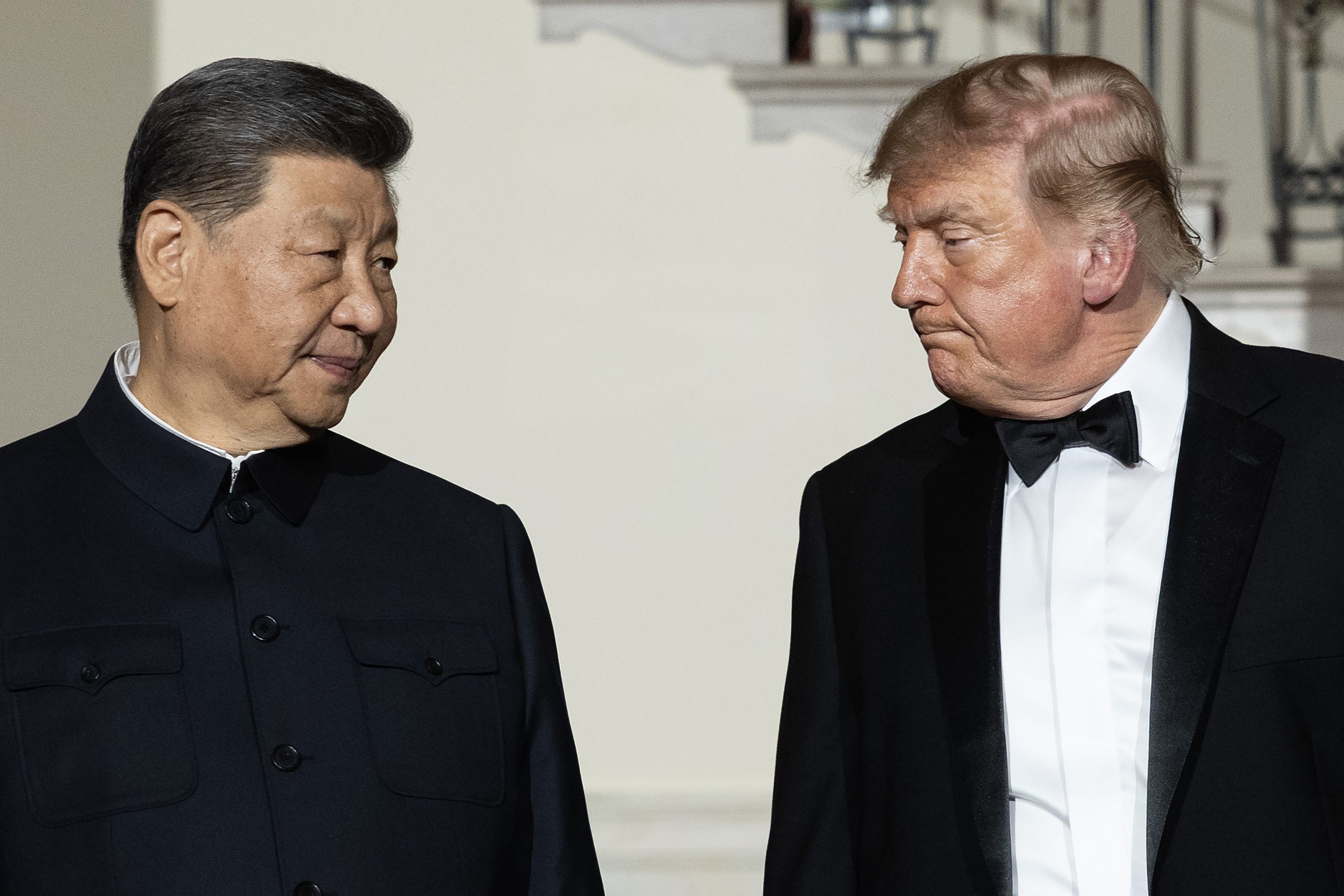



Summits between American and Chinese leaders often seem to mark turning points in international politics. In the 2013 meeting in the Sunnylands, the freshly installed Xi Jinping mollified Barack Obama by promising to stop his regime’s hacking campaign. After breaking that promise, in 2016 Beijing denied Obama a staircase for Air Force One and forced him to exit “the ass of the plane” rather than get the normal red carpet. Last year’s showdown in Busan partly halted the trade war, and this year’s summit indicated that the uneasy truce will continue.
Many see this détente as an indication of America’s growing weakness and China’s rising strength. Some even claim this summit marks China’s coming-out party as an equal to the United States in global power. Neither view is correct. Both nations have large vulnerabilities, and Trump and Xi used the summit to try to minimize their weaknesses and shift the competition to areas where they believe they have an advantage.
China’s earlier triumphalism has somewhat faded, but the conventional wisdom held that Trump was in the weakest position leading into this meeting. Iran has spread the Middle East conflict to Yemen, where its Houthi minions threaten to close the Red Sea shipping lanes and cut off Asia’s access to Middle East oil. The global price of oil is still high, the price at American pumps is 50 percent greater than before the war, and the midterms are looking grim for Republicans. Geopolitically, America’s allies are aghast at some of Trump’s actions, and Europe’s willingness to fund Ukraine’s defense is waning.
But things are not looking so hot for Xi either. Other than a few sectors that enjoy massive state subsidies, China’s economy is grinding along slowly. Debt and urban youth unemployment are climbing. Xi keeps purging military leaders—only one other member of the Central Military Commission is still notionally free—which suggests he lacks confidence in his control of the military. And for all the talk of a green transition, China is worried about global oil markets: Beijing asked Tehran to rein in the Houthis.
Trump is going out of his way to smooth things over with Xi, but both are furiously chipping away at each other where the cameras aren’t looking. China seeks to isolate and demoralize the Taiwanese, and the Pentagon is quietly building up its ability to operate with nearby militaries in the waters around China. Trump has at times dismissed Taiwan’s importance, but his uncharacteristically guarded statements about responses to hypothetical Chinese actions reveal he isn’t interested in giving away the island democracy.
China is trying to get the Taiwanese to do themselves in. Xi is actively boosting pro-appeasement candidates for the 2028 elections. Getting a sufficiently pliant conspirator installed in Taipei could ease the way for a Hong Kong-style takeover rather than requiring a massive military action. A similar pressure campaign by Xi backfired in 2020 and revived President Tsai Ing-wen’s floundering reelection bid, but he is betting that years of unrelenting military exercises, cyberattacks, and propaganda will cow the Taiwanese.
If Europe wakes up to the China threat though, he’ll have bigger concerns. China’s cheaper electric cars threaten to swamp Europe and destroy the auto companies that have formed the backbone of the European political economy. Volkswagen, which earned more revenue than any other German company in 2024, is cutting 100,000 jobs and was just kicked off the blue-chip Euro Stoxx 50 index. China already cannot dump its cars in the United States: If the Europeans take a similar step, Xi’s economic problems will intensify.
The biggest wildcard is AI. It is not entirely clear yet how advanced computer intelligence will affect the physical world, but it promises to revolutionize robotics and biotechnology. If American companies can harness this power first, it could put a big dent in China’s strategy of overwhelming foreign competitors with cheap exports.
A second-place finish after the United States is not the only threat to the CCP: As Walter Russell Mead pointed out this week, the party’s legitimacy will take a huge blow if AI isn’t impressed by the scientific laws of history allegedly uncovered in Xi Jinping Thought. A man who fears being compared to Winnie the Pooh won’t handle it well if he invests enormous resources in programs that demonstrate his pet ideas are bunk.
Some kind of hotline or other safeguard for AI is under discussion, but Trump says it will not amount to much. “I want to leave it exactly where it is,” he said Thursday.
This week’s pageantry and pomp are diverting. But the struggle for power will determine who dominates the next century.
Read the full article here