




George Orwell, in his immortal 1946 essay “The Prevention of Literature,” delineates a distinction between two types of attackers of intellectual freedom, both real but one in a sense more real than the other. “On the one side,” he writes, “are its theoretical enemies, the apologists of totalitarianism, and on the other its immediate, practical enemies, monopoly and bureaucracy.” This distinction is at least as useful in the age of Trump and social media.
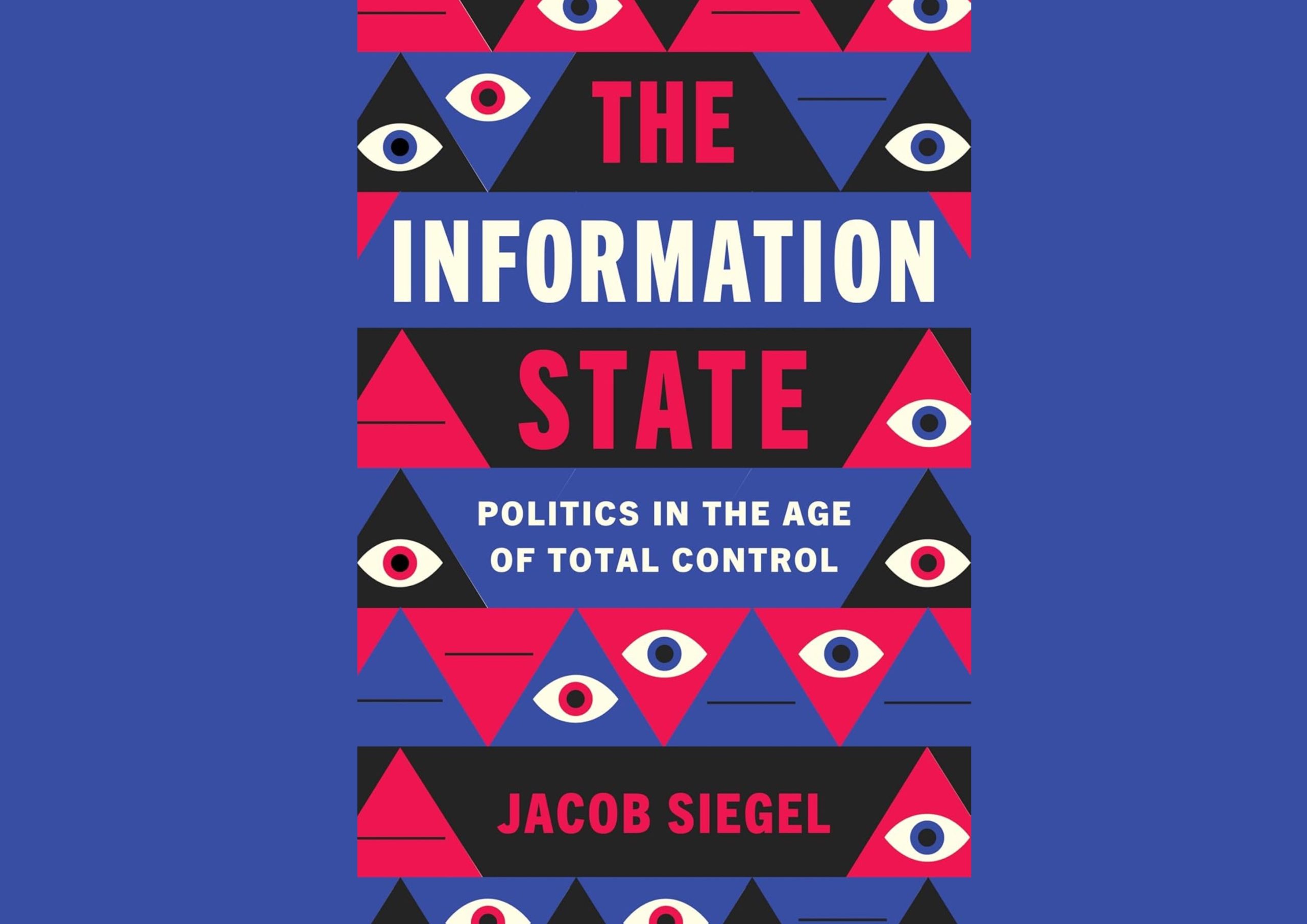
The new book by journalist Jacob Siegel, The Information State: Politics in the Age of Total Control, is a structural and historical examination of the ways that in the information age, with the help of the right kind of journalists and officials working to craft narratives, the practical enemies of freedom triumph over its theoretical friends. And more ambitiously, it is an examination of the ways that information technology actually necessitates this process.
The internet, Siegel argues, has for practical purposes created a totally new form of depersonalized tyranny that is hard to understand in terms of Americans’ previous, legalistic notions of political power or censorship. After all, the most powerful entities today, in terms of shaping the public understanding of reality, are not usually government ones. As an American, for instance, I am theoretically protected from much government censorship by the First Amendment, and the norms of my society guard against government agencies doing too much overt domestic propaganda outwardly seeking to change my mind one way or another. But practically, as a modern information worker who spends hours online almost every single day, what I see and do not see as I seek to understand the world around me is determined in very large part by powerful forces whose interests and doings are not particularly apparent to me. Somebody in San Francisco could almost certainly cause me to become very worried about, say, the fact that men and women these days ain’t like they used to be, or the genocide in western Abkharia, or the rising threat of disinformation. That’s true even though there is no such place as Abkharia.
To explain how we got to a place where the most powerful forces in our lives are difficult to discern, Siegel tells a more-than-a-century-long story beginning in the Progressive Era in World War I. The original, capital-P Progressives, whose apotheosis was Woodrow Wilson, were deeply technocratic—they sought to put government policy outside of the scope of politics itself, and into the hands of credentialed and unelected experts. “What Wilson called administration and is often termed bureaucracy was the first great technology of political control,” Siegel explains, as he gives a useful history of the ways technocratic governance requires propaganda to bring the public along with what the administrators have decided is right. He does an admirably clear job bringing in the history of information theory and political philosophy—with regular invocations of thinkers like Max Weber and Jacques Ellul—without for a moment becoming boring or academic.
Alongside this essentially political story, Siegel tells the more obscure tale of how the technology of surveillance and control, which became our internet, developed. While it has been popular to describe the personal computing and internet era as originating in the garages of California entrepreneurs, it is more accurate, Siegel shows, to understand the tools of our information age as coming from the government. Specifically, personal computing and the internet are technologies that came from, and never really separated from, the American defense and intelligence departments. “War and machines evolved together,” he writes. In one memorable passage, Siegel explains how it was in Vietnam that the first attempt to map an entire physical space in real time digitally was conceived. One eventual descendant of that is your ability to use Google Maps, but another is that you can be tracked at virtually all times.
The point of the first half of the book is that technology should be understood almost like it seeks information of its own accord by a sort of bureaucratic logic that plays out without having to attribute its intentions to any one person or party. But most of that is, at this point, distant history. Where it becomes salient is in the second half of the book: Siegel gives the most exhaustive and unimpeachably sourced account of how—since Obama’s first term, say—the mature versions of information technology, whereby we “live inside the digital embrace,” have been harnessed in a way that amounts to a practical tyranny we live under often without even noticing it.
Usually, though not always, it has been wielded by Democrats. Most interestingly using the example of the panic around “disinformation” that gripped the media in the first Trump administration, Siegel describes “a new technique of governance that circumvented the normal legislative process by seizing the levers of the digital system to enact sweeping policy changes.” If the government is forbidden from directly practicing censorship, it is not forbidden from working closely with officially private and independent NGOs that work with a web of academics who work with tech companies who practice censorship.
Siegel shows how the triumvirate of the press, tech companies, and NGOs worked with the government to create a system of control that, sinisterly, worked first and foremost to obscure its own existence, even as it shaped the sense of reality of the citizens of the democratic world to its own ends. “By early 2020, with the next election approaching, the information state had metastasized into one of the most powerful forces in the modern world: a sprawling leviathan with tentacles reaching across continents and into every corner of American society as it took control of the Internet and worked to achieve nothing less than the eradication of harm and human error.”
Big claims, surely. The outlines of the stories Siegel tells about the tools of information warfare being turned inward, using his journalistic background as well as his experience as a U.S. soldier, are enough to make someone sound like a crackpot. Which is why it is so crucial and welcome that Siegel is careful and specific in providing the gory details.
And they are gory. Siegel names names, telling the stories of individual characters who rotate through the revolving door of presidential administrations, academia, U.S. intelligence, and NGOs to create the infrastructure for information control during a time when “the national security apparatus was reorienting away from foreign groups to focus on Americans and their activities online.” Readers of this publication will know at least much of what happened next, with social media companies and the Biden administration working to suppress stories unflattering to Democrats, like those about Hunter Biden, including in direct messages. Something called the Election Integrity Partnership, using the sleazy legal loophole that elided the First Amendment restriction on government censorship by using officially private cutouts working in concert with government, passed almost 22 million “takedown requests” for specific posts to social media companies via a “ticket” system that saw tech platforms responding, on average, in under an hour. Meanwhile the press practiced a double standard whereby the successful political use of social media by Republicans was an occasion for panic and by Democrats for celebration.
Together, these methods exemplify what had become “the ruling party’s power to instantly disappear countless discrete pieces of information across billions of screens while penetrating into people’s private communications.” They were also, largely speaking, legal. Which brings us to what is ultimately the deepest claim of The Information State, that “charting the structure of American politics in the twenty-first century require[s] a new set of terms.” The internet has, in a sense, created new practical opportunities for attacking liberty, yet we are still stuck in outmoded and theoretical conversations about what attacks on liberty look like.
Readers of the Information State, which is sure to become one of the most talked-about books of the year, will be armed with the vocabulary to describe and understand the world we have all been living in for some time.
The Information State: Politics in the Age of Total Control
By Jacob Siegel
Henry Holt and Co., 336 pp., $29.99
Nicholas Clairmont is an editor at The Free Press.
Read the full article here