


‘National Palestinian Radio’ has become an unlistenable laughingstock
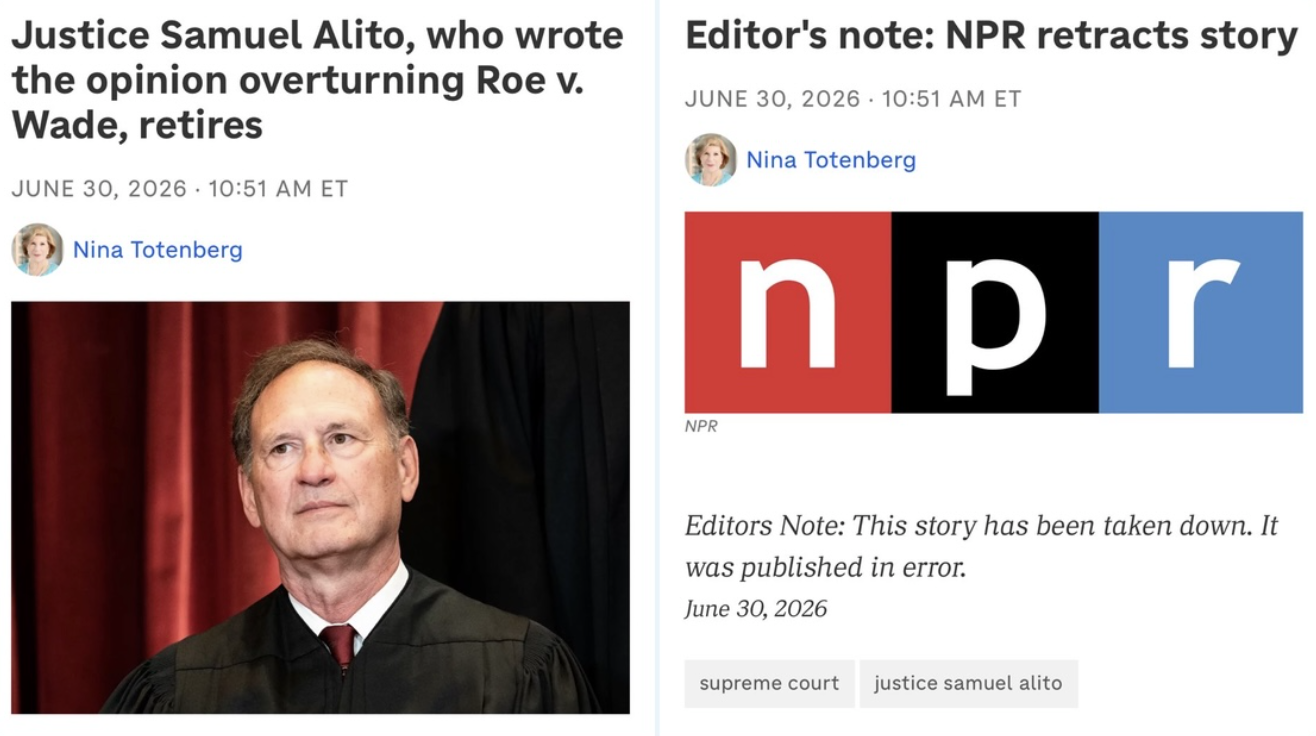
NPR has retracted its story claiming that Justice Alito is retiring, replacing it with an editor’s note explaining that the story “was published in error.”
The coming days will disclose whether the error was publishing it a few days too soon or publishing it at all. NPR attributed it to “a misunderstanding” by 82-year-old Nina Totenberg, who has been at NPR for half a century. Either way, at least in this situation NPR editors publicly acknowledged an error and took the story down. That’s more than they’ve done for hundreds of other articles that are similarly erroneous but, alas, remain unretracted and without editor’s notes on NPR websites and audio platforms.
I stopped listening after October 7, 2023, and then I stopped listening again after President Trump took office again, because it’s become basically unlistenable. The only reason to listen was to gather evidence of bias that could be used to remove the taxpayer subsidies. Once Trump and congressional Republicans succeeded in eliminating the taxpayer subsidies there really was no reason left to listen. I guess I checked in once or twice curious about whether the removal of the government subsidy had somehow chastened NPR into more accurate, less biased coverage. Maybe they were aspiring to get the funding back by demonstrating improvement? Instead it seemed that the loss of government funding had only unleashed NPR to bare its left-wing bias without apology. They no longer had anything left to lose, money-wise, and the funders who stepped in to fill the gap were left-wing foundations and individuals who weren’t interested in fair-and-balanced coverage so much as they were in having their opinions confirmed about how horrible Trump is.
The Committee for Accuracy in Middle East Reporting and Analysis, a watchdog organization that I’m on the board of, documents dozens of examples of NPR sliming Israel while playing propagandist for Hezbollah and other terrorist groups. “NPR has not only crossed the line of no return, but has abandoned the basic moral compass that news consumers should demand from journalism,” Camera’s Jennifer Kouzi wrote in one recent piece.
The Media Research Center, a conservative research group, also has countless examples of NPR’s left-wing tilt. “National ‘Public’ Radio sounded like National Mamdani Radio,” one recent Media Research Center piece said, faulting the outlet for showering New York City mayor Zohran Mamdani with softball questions “that sounded like what Democrats would ask at a precinct caucus.” Another Media Research Center item was headlined, “Lefty NPR Indulges Fans of Alleged Murderer, Sex Symbol Luigi Mangione: ‘He’s Hot.’”
Foreign NPR segments frequently feature reporters in Lebanon who would be killed by Hezbollah if they told the real story of what is happening there rather than amplifying what Hezbollah wants western audiences to hear. Political coverage of Washington starts from the premise that President Trump is a norms-breaking would-be-tyrant jeopardizing democracy and the rule of law. Reporters from other left-leaning news organizations, book authors, left-wing professors, and officials of left-wing advocacy groups are brought on-air to support the baseline alarmist premise, fueling anxiety among NPR listeners. The implicit argument is that the only way to preserve American democracy is to donate to NPR so they can stay on the air warning about how endangered American democracy is.
The catastrophism, the oversimplification, is on display routinely. Here’s a piece from NPR’s home page today, headlined, “After Trump’s reelection, these U.S. scientists found jobs in the U.K.” It begins “For decades, the U.S. was seen as a nation that prized its universities and scientific researchers. That changed when President Trump began his second term, says Megan Peters, a cognitive scientist at the University of California, Irvine. ‘It became very apparent, very quickly, that the new administration did not value higher education,’ she says, or the scientific research done at universities. ‘So when I went on the job market, I started looking around overseas,’ Peters says.”
There’s no skepticism about the claim that Trump, who touts the Ivy League credentials of every Ivy League appointee he appoints, does “not value higher education,” no consideration of why, if Trump doesn’t value higher education, he has devoted so much energy to trying to reform it, and no questioning of why someone’s connection to the U.S. is so attenuated that their response to a federal policy change is to flee to a foreign country. It’s just a straight-up panicdote suggesting that fleeing elsewhere is a rational response to the Trump presidency.
It’s so predictable that it’s boring. Part of the fun of radio is the serendipity, the surprise, the hearing a story that’s unexpected. You don’t get that from an anti-Trump, anti-Israel audio newsletter, which is what NPR is these days. An “Editor’s Note” with that confession would be a welcome surprise.
Read the full article here