





Federal Reserve policymakers are increasingly concerned about inflation, and the uncertainty about the direction it may take was reflected in the minutes of the Fed’s latest monetary policy meeting released on Wednesday.
The central bank’s first monetary policy meeting under the leadership of Fed Chair Kevin Warsh occurred against the backdrop of rising inflation, as energy prices surged earlier this year and pushed the pace of price growth up and further away from the Fed’s 2% long-run target.
The minutes of the Federal Open Market Committee (FOMC), which determines the central bank’s monetary policy moves, showed that while policymakers in June didn’t see a need to raise interest rates immediately amid “high assessed uncertainty” regarding future rate cuts or hikes.
Policymakers voted unanimously to leave the benchmark federal funds rate unchanged at a range of 3.5% to 3.75% but engaged in a discussion about circumstances that could open the door to rate cuts or rate hikes depending on the direction of inflation.
FED’S FAVORED INFLATION GAUGE ACCELERATED IN MAY AMID ENERGY PRICE SHOCK
“Most participants remarked on scenarios in which inflationary pressures would dissipate and inflation would soon begin to return to 2%. In such scenarios, almost all of these participants noted it would likely be appropriate to maintain or eventually lower the target range for the federal funds rate,” the FOMC explained.
“Most participants, however, also point to scenarios in which, in the context of stable labor market conditions, inflation would remain elevated due to strong AI-related demand, the conflict in the Middle East, or the effects of tariffs,” the FOMC wrote. “In such scenarios, almost all of these participants indicated that some policy firming would likely be warranted to return inflation to 2%.”
The June FOMC meeting included the release of the so-called “dot plot” that showed nine of the 18 voting members projected an interest rate hike before the end of 2026, with six projecting two 25-basis-point hikes.
FEDERAL RESERVE LEAVES INTEREST RATES UNCHANGED AS WARSH ERA BEGINS

The summary of economic projections also revised its forecast for PCE inflation at the end of this year up from 2.7% as of the March projection to 3.6%, reflecting recent inflationary trends.
Warsh has said he wants to end “forward guidance” in how the Fed communicates about future rate moves and declined to submit his own economic projection as part of the FOMC’s forecasts and post-meeting message.
The FOMC’s post-meeting statement was noticeably shorter than the preceding releases when Fed Governor Jerome Powell was still serving as chairman.
AMERICANS GROW MORE PESSIMISTIC ABOUT FINANCES AS RENT AND FOOD COST FEARS SURGE, FED SAYS
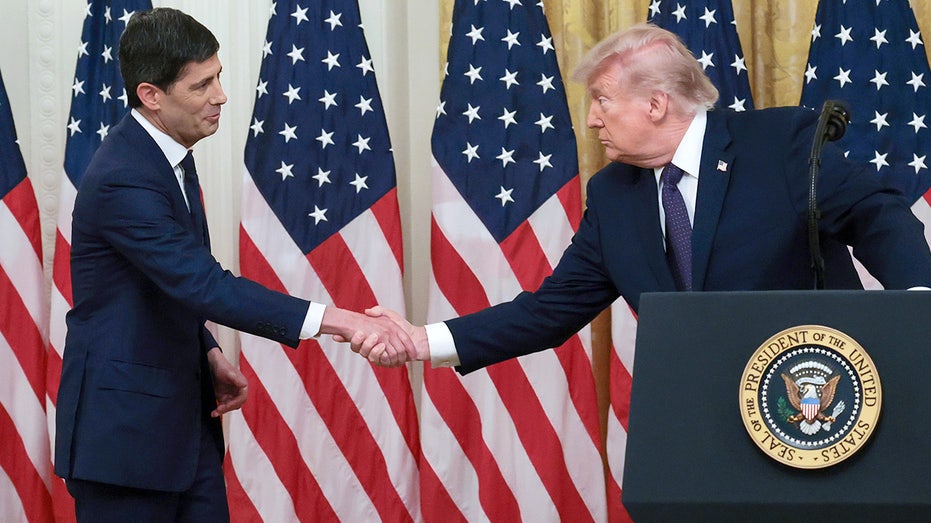
The minutes showed that some policymakers viewed Warsh’s first meeting as “an opportune time to consider significant changes to the FOMC’s post-meeting statement.”
“A majority of participants remarked that they saw advantages in shortening the statement. Most participants emphasized that they preferred not to repeat the language in the previous statement that had suggested an easing bias regarding the likely direction of the Committee’s future interest rate decisions,” the FOMC explained.
Read the full article here