






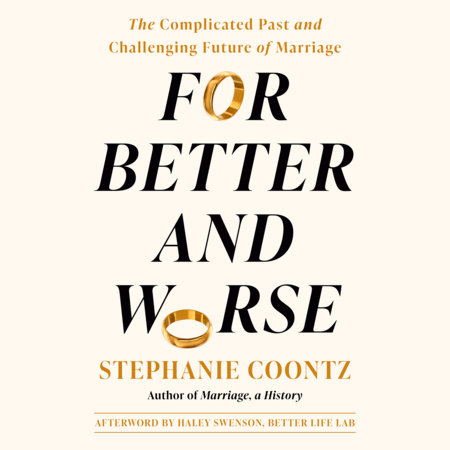
“In recent decades,” Stephanie Coontz writes, “many parts of the world have seen a revival of the more pernicious form of nostalgia … the longing to re-create not a pleasant feeling or specific experience from the past, but rather a bygone way of life.” Coontz, considered one of the foremost experts on the history of marriage, is very concerned about people trying to re-create the 1950s. But one gets the sense reading her new book, For Better and Worse: The Complicated Past and Challenging Future of Marriage, that she would like to re-create the Stone Age.
Coontz writes that there is “no way of knowing for sure the interpersonal dynamics of marriage and male-female relationships among our ancient ancestors” but that researchers agree “there is no evidence in either the ethnographic record or the archaeological record of band level societies that they practiced the systematic oppression of women or the punitive attitudes toward children born out of wedlock characteristics of the stratified societies that arose later.” She notes that bands were “remarkably accepting of premarital sex by women as well as men,” that there were cases of wife-beating but they were generally frowned upon, that women were “free to leave their husbands” and that children born outside of marriage “have a full claim on the group’s resources.” In Coontz’s telling it was only once people began to develop agriculture and domesticate animals—that is, they could accumulate surplus resources—that these communal paradises began to disappear.
In her account, property rights begat inequality and inequality produced “the rise of patriarchal marriage.” With the growth of these societies, according to Coontz, fathers and husbands “carefully monitored women’s sexual behavior in order to safeguard the patrilineal inheritance of property and ensure that a wife or daughter would not introduce unwanted blood lines and allegiances into their families.” Coontz cites diaries from Jesuit encounters with indigenous people in Canada in the 1600s to support this idea. But there are good reasons to think Native bands in North America were not just a bunch of roving kibbutzniks even back then. There is plenty of evidence they believed in property rights. And even if they left some territory and their dwellings for a season they expected to come back and claim it later.
In the 1974 Boldt decision, for instance, which granted fishing rights to Indians in the Pacific Northwest, presiding judge George Boldt cited the history of Indian fishing in the area in his ruling: “Generally, individual Indians had primary use rights in the territory where they resided and permissive use rights in the natal territory (if this was different) or in territories where they had consanguineal kin.”
But let’s assume that property was really not much of an issue. Is it plausible to believe human beings—alone in the animal kingdom—didn’t really care who their offspring were? To the extent that bands were just extended families, perhaps the men saw the perpetuation of the tribe as the best way to pass on their genetic material. Nevertheless, Coontz sees sexual jealousies and concern about which child belonged to whom as largely a product of the modern era, not anything that is related to human nature or evolutionary biology.
Readers will not be surprised given the political drift of For Better and Worse that Coontz argues Christianity is in part responsible for the oppressive system of marriage that has continued through to our modern era. The Church’s ways of sanctifying or annulling relationships, making children legitimate or illegitimate, rendered it complicit in what she sees as women’s oppression. But then she explains that Jesus really had a different understanding of marriage, and his followers have missed the point. Passages in the Bible, according to Coontz, suggest “that Jesus endorsed an understanding of social obligations close to that of our hunting-and-gathering ancestors … than to the narrow ‘family values’ we sometimes hear preached today.” It is possible to believe that Jesus wanted his followers to see themselves as belonging to a larger family and that Christians should have some kind of communal responsibility to others without suggesting he didn’t care about sex outside of marriage or that parents don’t feel a special obligation to their own children.
If it seems a little odd for Coontz to be engaging in such theological speculation, just wait until you hear her economic theories. For those who are nostalgic for the 1950s, Coontz wants to warn readers that not only were those times not great for women, the only reason they worked as well as they did was because of the country’s rapid economic growth. And the post-World War II economic boom was not, she assures us, the result of “free enterprise”—her quotes—but rather because of “government-funded job creation, stricter regulation of businesses and banks, higher tax rates on the wealthy than today, and stronger guardrails against financial piracy.”
What does any of this have to do with marriage? Well, if you nostalgic folks want to return to an era where one income was enough to support a family then you will need to enact all of these policies. Coontz doesn’t really want one income to be enough to support a family, though, unless that one income is being earned by the wife. At any rate, it was all ruined because of a conspiracy of “corporate executives and wealthy families.” Since the late 1970s, Coontz writes, “wealthy individuals and politicians who want to deregulate Wall Street and repeal restrictions on corporate and billionaire entitlements forged alliances with groups wanting to re-regulate women’s bodies and reimpose restrictions on people’s sexual and marital choices.”
She cites Jerry Falwell’s support of the “free market”—noting that “some may find it hard to reconcile such a supposed endorsement with the biblical pronouncement that the ‘love of money is the root of all evil’ and the New Testament’s exhortations to ‘feed the poor and shelter the homeless.'” Of course, many do not find these ideas difficult to reconcile because being in favor of free markets doesn’t mean you love money so much as you love freedom or that you think it’s the system most likely to lift people out of poverty and provide enough resources to offer a safety net to the poor and the homeless.
For Better and Worse isn’t so much a history of marriage as a history of ideas that Coontz does and doesn’t like. Roving tribes were good because their women were ostensibly treated better. Christianity was bad, though Jesus was good. The 1950s were bad, but the late ’60s and ’70s were good. Coontz writes that “police records, psychologists’ accounts, oral histories and marital surveys” from the ’50s “reveal that many seemingly ‘stable’ marriages of the postwar era were marked by substance abuse, domestic violence, infidelity, or simple day-to-day misery.” Exactly how many is “many”? Who knows? If we are just measuring the value of marriage by day-to-day misery, it’s probably worth noting that women today report much lower rates of happiness than their mothers and grandmothers and that the women today who report the highest levels of satisfaction are the ones who are married.
Coontz says that earlier “couples stayed together not because they were better partners but because they had fewer alternatives—as well as lower expectations.” Some probably did. But we must wrestle with the idea that more alternatives and higher expectations have not necessarily produced a greater feeling of fulfillment for women or for men. Nor have they produced more stable households for children.
Which brings us to today. No surprise, it’s bad. Coontz notes that marriage has become much less common—she doesn’t seem to have strong feelings about that either way. She dismisses research about the positive effects of marriage on families’ economic success as largely correlation. Economist Melissa Kearney’s The Two Parent-Privilege—which refutes much of Coontz’s speculation pretty decisively—doesn’t even merit a footnote. She does acknowledge that rates of marriage among blacks used to be much higher—they were even higher than white rates in the first part of the 20th century—but then Coontz blames racism for today’s lower rates. “America’s distinctive racist traditions … have created an accumulation of economic, social, environmental and personal stressors for African Americans that simply have no counterparts among Whites.” So is racism more powerful today than it was in 1940?
The inability to put into any kind of historical context the environment of America today pushes For Better and Worse from half-baked into something unhinged. When Coontz, for instance, notes that the ’50s were a period of “heightened repression of gay men and lesbians,” what is she comparing it with? Were things better in medieval Europe? During the American Civil War? In ancient African tribes? She warns that the federal government in the 1950s dishonorably discharged gays and lesbians from the military “in what now seems like a dress rehearsal for 2025.” Leaving aside that this did not happen in 2025, does she think that 21st century America is an environment of heightened repression for gays? For women? For blacks? For better and worse, to borrow a phrase, we live in the most free and open society the planet has ever seen. And Stephanie Coontz would like to send us back to the Stone Age.
For Better and Worse: The Complicated Past and Challenging Future of Marriage
by Stephanie Coontz
Viking, 291 pp., $30
Naomi Schaefer Riley, a senior fellow at the American Enterprise Institute and the Independent Women’s Forum, is the author of No Way to Treat a Child: How the Foster Care System, Family Courts, and Racial Activists Are Wrecking Young Lives.
Read the full article here