


For people who have not been initiated to the career of Jon Ronson, it is almost impossible to explain; for people who have, his career is almost impossible to ignore.
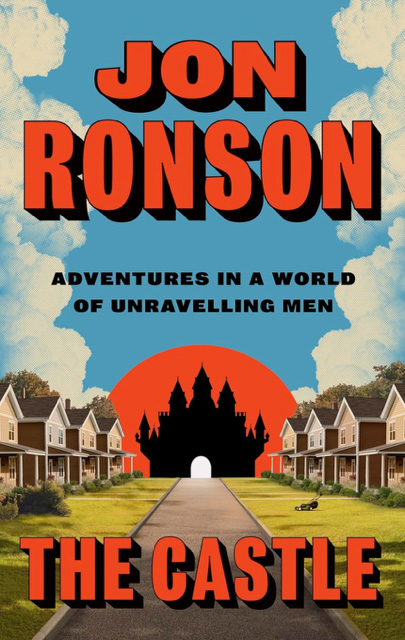
The America-residing Welsh journalist, whose specialty may be said to be “the weird,” is a member of a small and shrinking group of working nonfiction writers who could be recommended to anyone today regardless of political or cultural affiliation. (Beacon readers would be well served to overcome their likely distaste for The Guardian to read his masterly two-part investigation into whether a foiled school shooting in the town of North Pole, Alaska, was staged because the town is “too Christmassy.”) His approach has been criticized, as he notes in his new book The Castle: Adventures in a World of Unraveling Men, as “pseudo-naive.” That is, he enters the worlds of his subjects giving off the impression that he knows very little and needs things explained to him, even though he is a careful researcher and interviewer who often deftly walks his subjects into being more revealing than they ought to for reasons of self-preservation.
This criticism can be written off as the scandalous sensation people sometimes get when they hear about the everyday reality of journalism done well—with the added wrinkle that Ronson’s sheer Hugh Grantesque bumbling Britishness can make him seem more addled and disarming than he really is. Like previous Ronson books such as The Psychopath Test, The Men Who Stare at Goats, and So You’ve Been Publicly Shamed—as well as recent podcasts produced with all the care of a full-on nonfiction book, like his excellent examination of all the things that happened because PornHub was created, The Butterfly Effect—The Castle is structured as a sort of investigation into an idea that begins to trouble Ronson about whether some small and previously unnoticed feature of reality actually explains a great deal. He takes you the reader along with him as he works out his own confusions and questions. None is resolved perfectly, but the curiosity is infectious, and it’s hard not to come away suspecting the answer is at least in the direction Ronson is headed in.
In this case, the issue in question is whether, as modern society has been restructured over the past few decades toward the therapeutic and the digital and away from the concrete, men are losing it. Many books have at least glanced at this subject, usually with a big prefatory defensive gesture that surely we all know women are the real subjects of concern. Richard Reeves and his book Of Boys and Men stands out among them. But the majority of the work on the subject comprises liberal fearmongering about the “manosphere,” the internet subculture of blustering, often whoremongering dudebros such as Andrew Tate who openly advocate for polygamy and pumping iron and whatever supplement they’re selling. The manosphere is bad just like QAnon is bad, but the coverage of both seems less interested in telling human stories in their real scale than threat inflation aimed at flattering the liberal suspicion that all rightwingery is explained by bigotry that is either more or less open.
Ronson, despite being much more fun and funny to read, takes the subject of modern male struggles more seriously and humanely. Indeed, despite (or because of) taking a much fuzzier and more circuitous approach to the question of what is going wrong with men than any comparable book, The Castle is the best of the bunch.
One of the most interesting throughlines in The Castle comes when Ronson writes about his own absurd but real-to-him struggle for male purposefulness, and his fear of turning into a lost man himself if he is not competing to be the best through his work. Men, after all, thrive when our lives are structured in ways that push us to be skillful, strong, and stalwart. Without outlets that channel male energy toward those things, you get despairing men expressing their rather unpleasant ids. It is the stories of these men that we follow in The Castle.
The title story, and the one that weaves throughout the book, is that of Chris, a steel fortune heir who has built a literal castle in Connecticut. (A note on the title: It is generally a bad idea to give anything the same name as a canonical great work of literature. The magazine Persuasion is pretty good, but I make fun of it a little in my head every time I read an article. Kafka fans may find themselves a little distracted reading this one, similarly.) Ronson catches wind of Chris’s apparent grubby attempts to use his wealth to, Hugh Heffner-like, woo a harem of women to his mansion using dating apps and an internet reality show, and ends up spending years investigating and playing a part in the psychodrama of this man, who by all appearances shows signs of being on some kind of constantly wounded yet horny bipolar rollercoaster of paranoid manias.
In between the chapters about Chris and his attempts to, among other things, threaten Ronson with murder, Ronson tells the stories of other men who are coming apart. There is the aspiring young journalist who pivots to a cheap form of antiwoke YouTube influencing. There is Ronson’s old friend Graham Linehan, the writer of the great Irish soap opera Father Ted, driven to such rage by his monomania about trans issues that his own friendships and marriage and career are destroyed. There is the steel town owned by Chris’s grandfather, which has by now turned to a desolate and jobless gangland. There is the handsome actor who has been typecast into playing the “hapless man,” a standard type in advertisements that emerged to replace the harried housewife for cultural reasons Ronson bears out. There is the single dad who was canceled online after becoming one of the most viewed creators on YouTube, pulling his life back together after years in a sort of social exile caused by unfair accusations of child abuse. (A subtheme throughout the book, and all of Ronson’s work since Publicly Shamed, is the idea that the very dynamics of the internet are driving everyone to act insane.) There is Armie Hammer, the actor who was revealed through leaked texts to have a cannibalism fetish and ruined socially.
A shared feature in each case, sometimes suggested and sometimes stated, is that in an earlier era each of these subjects would have done just fine or even flourished, but the modern world has instead offered a rough treatment according to an ever-shifting set of rules that are usually unstated. It is, in other words, their very maleness for which these men are being punished. Is this fair? Perhaps that is a childish question, or a pointless one. But when it is your life it is one that is hard not to ask, and impossible not to dwell on.
For Ronson, it is enough to simply bear out the stories of strange and unexpected circumstances that cast light on where we are and what a good-hearted and curious person might think about it all, if he wishes to understand. Trying to understand by examining human stories that cast light on larger elements of our culture is after all Jon Ronson’s craft, and The Castle is another example of why he is a master at it.
The Castle: Adventures in a World of Unraveling Men
by Jon Ronson
Riverhead Books, 336 pp., $32
Nicholas Clairmont is a writer who lives in Virginia.
Read the full article here