




A highly anticipated research report linking human-induced climate change to extreme weather events lists a lawyer and multiple researchers who have ties to high-stakes lawsuits Democrat-led states have filed against oil companies in its “acknowledgments” section. The report’s findings may now be used in that same litigation, which, if successful, could cost the energy industry billions of dollars.
The report, published Thursday by the National Academies of Sciences, Engineering, and Medicine (NASEM), concluded that “human-caused changes to the thermodynamics of the climate system have a direct and well-understood impact on extreme temperatures, extreme rainfall, and compound hot-dry events.” Those findings could be a boon for the lawsuits that seek to link oil companies’ products to weather damages: “A report with the kind of gravitas that the National Academies can bring will be a huge boost to the plaintiffs’ cases,” Pat Parenteau, an emeritus professor at Vermont Law School who has advised lawyers on those cases, told E&E News prior to the NASEM report’s publication.
The New York Times added Thursday that the report “could support lawsuits seeking damages for severe events worsened by global warming.”
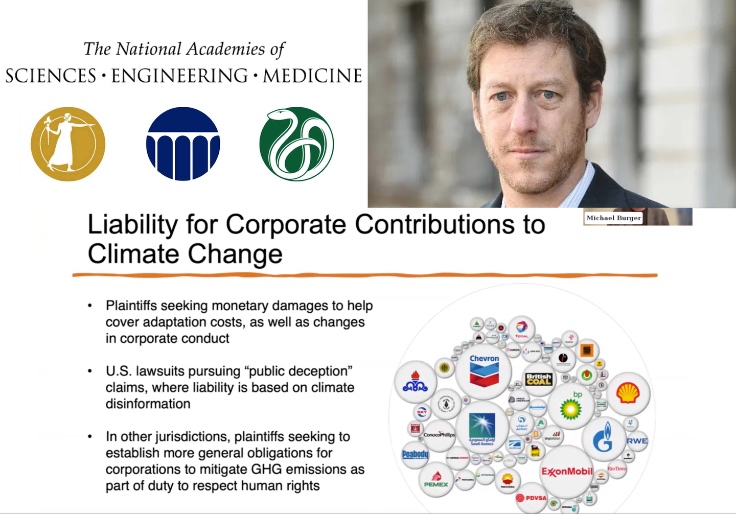
The NASEM report, though, acknowledges legal scholar Michael Burger for his contributions and cites his research four times. Burger serves as of counsel at Sher Edling, a California law firm suing oil companies like Chevron and ExxonMobil for climate-related damages on behalf of Democrat-led states and cities that are home to a quarter of the American population. Burger is listed on Sher Edling’s lawsuits filed on behalf of New York City, Honolulu, and Delaware, according to a Washington Free Beacon review. Sher Edling states on its website that Burger helps “public agencies hold fossil fuel companies accountable for the climate change related damage they knowingly caused.”
Burger’s contribution to the report appears to have included a presentation he delivered to the NASEM’s Committee on Attribution of Extreme Weather in November 2024, laying out how litigation against oil companies has progressed. Following the presentation, NASEM committee member Deepti Singh, a Washington State University Vancouver climate professor, asked Burger how the committee could “do better” at designing studies to “better inform litigation.” “The science needs to keep evolving and that’s what’s going to inform the litigation,” Burger responded. “It’ll work the other way around a little bit, but that’s the way that that’s gonna be most potent.”
The report ultimately identifies Burger’s affiliation as Columbia University, where he serves as the executive director of the school’s Sabin Center for Climate Change Law. It fails to mention his work for Sher Edling, even though he informed NASEM leaders during the 2024 presentation that he was “actively involved” in the firm’s cases.
In addition, the NASEM report’s authors list Arielle Tannenbaum and Shel Winkley, two researchers with the left-wing research nonprofit Climate Central, in its acknowledgments and cites Climate Central studies that link extreme weather to human-induced climate change. Climate Central has long sought to tie recent or ongoing extreme weather events to climate change using a methodology that experts have characterized as “entirely political.” In addition to tying the use of oil and gas to various hurricanes, heat waves, wildfires, and floods, the group has recently published articles outlining how climate change cast a dark cloud over America’s 250th Independence Day celebrations, blaming climate change for sleep loss, and predicting global warming would make World Cup games less competitive (it didn’t).
Climate Central’s funders include the Freedom Together Foundation, the MacArthur Foundation, the Tides Foundation, Chicago Community Trust, the Hewlett Foundation, and the Marisla Foundation, left-wing charities that have given it $13.4 million since 2017, according to their tax disclosures. In that same time frame, those same organizations have collectively funneled $26.5 million to a fund that was created to support Sher Edling’s anti-oil litigation.
In a statement, a spokesman for Climate Central said the group is “a science-based non-advocacy organization.” “Our work includes climate attribution, and we agree with the report’s conclusions that there is a strong scientific foundation for attribution science and clear connections between climate change and extreme weather events,” he added.
The NASEM, meanwhile, notes that the Heising-Simons Foundation, another left-wing charity, provided direct grant funding for the report. In addition to giving millions of dollars to green energy advocacy initiatives in recent years, the foundation is a member of the America Is All In coalition, which is led by former Biden White House climate czar Gina McCarthy and California governor Gavin Newsom (D.), and seeks to slash America’s carbon emissions in half by 2030. The group’s vice chair, Mark Heising, serves as the chairman of the Environmental Defense Fund, a legal nonprofit that uses the courts to push “climate justice.”
Both of the foundation’s cofounders, Heising and Liz Simons, are prolific Democratic Party donors—they have given more than $8.4 million to Democrats during the current campaign cycle, according to federal campaign finance records. In 2023, Simons notably gave a maximum state contribution of $9,100 to California attorney general Rob Bonta (D.) shortly after he filed his lawsuit against oil companies, according to state disclosures. The contribution came during an election cycle when Bonta was not up for reelection. Sher Edling is involved in that litigation.
The NASEM report’s ties to plaintiffs suing oil companies could present a conflict of interest if it is ultimately used in that litigation, according to experts interviewed by the Free Beacon.
“All of it is very suspicious and too convenient, and I think it is a way for the plaintiffs’ attorneys to slip in something that they otherwise wouldn’t have been able to put into their briefing papers,” John Shu, a constitutional law scholar who worked in both Bush administrations, told the Free Beacon.
“They have a serious credibility problem plus the fact that they’re trying to obscure the people who are involved, and all of their affiliations, because they have a clear conflict of interest,” Shu added.
Shu noted that the publication of the report comes shortly before the County of Boulder, Colorado, is set to submit its reply brief with the Supreme Court in its case against ExxonMobil and Suncor Energy. That case, which will be argued before the High Court in the coming months, could set the precedent for how all related cases against the industry proceed. Boulder’s brief, which may now cite the NASEM report, is due on July 27, 2026.
Overall, at least 10 Democrat-run states, Washington, D.C., and more than a dozen Democrat-run cities and counties have filed similar lawsuits that broadly accuse oil companies of causing global warming, deceiving the public about the harms of fossil fuels and therefore bearing responsibility for damages stemming from extreme weather events.
Critics say the cases are aimed at bankrupting America’s largest oil companies—if successful, oil companies would be forced to fork over billions of dollars in damages. For example, Multnomah County, Oregon, is demanding in its suit that companies pay it $51.6 billion in damages related to a heat wave that occurred five years ago.
“The National Academies has traded scientific neutrality for climate advocacy, and this report is the latest evidence,” said Jason Isaac, the CEO of the right-leaning American Energy Institute. “With the Suncor plaintiffs’ response brief due in just over a week, NASEM delivers a report backing the same theories driving that very lawsuit.”
It’s just the latest controversy involving the NASEM related to climate litigation. The group, which receives significant funding from the federal government, has stood by a climate chapter it published in the Reference Manual on Scientific Evidence, a handbook designed to inform how judges rule in cases involving scientific matters. The chapter has been criticized by Republican lawmakers and state attorneys general over Burger’s involvement in writing it. The other publisher of the manual, the Federal Judicial Center, removed the chapter from its website in February.
Read the full article here